
Listen to this podcast in the app for free: Download for free in the App Store
radio.net
Sleep timer
Save favourites
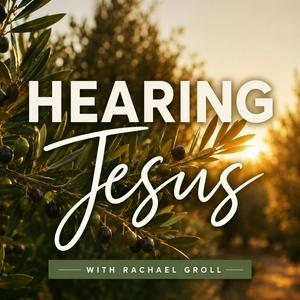
Hearing Jesus: Daily Bible Study, Daily Devotional, Prayer, Hearing God & Christian Affirmations
Rachael Groll
Latest episode
1537 episodes

Am I Doing Enough for God? Hearing God’s Voice in Luke 5:33-39 | Daily Devotional and Bible Study
2026-10-26 | 31 mins.Am I Doing Enough for God? Hearing God’s Voice in Luke 5:33-39
Most of us are carrying a mental list of what a serious Christian does. Read at 5am. Journal every insight. Pray an hour without your mind wandering. And when we don’t measure up to it, we assume we’re not as close to God as other people are.
I had planned to move into Luke 6 today, but the Lord kept bringing me back to the end of chapter 5. In our daily Bible study we’re still at Levi’s banquet, where someone brings Jesus that exact complaint about his followers. His answer surprised me. He doesn’t defend their devotion and he doesn’t apologize for them. He talks about a wedding, a torn garment, and wine bursting out of an old skin.
Join me on an immersive Bible Study Experience. Learn more at BibleStudyLive.org
Have a question about the series or a prayer request? Leave me a voicemail: SpeakPipe
Ad-free episodes and the full library of past series: Patreon
Questions we answer today
How often did the law actually require fasting, and how often were the Pharisees doing it? Was Jesus against fasting? What did a Jewish wedding have to do with any of this? Why can’t you patch a new garment onto an old one? What does it mean that we want Jesus sewn onto the life we already have?
Timestamps
00:00 Why I went back instead of moving into Luke 6
00:33 The mental list of what a serious Christian does
02:56 The complaint brought to Jesus
03:26 Reading Luke 5:33-39
04:41 Prayer
06:09 This isn’t a question about Scripture, it’s about behavior
06:32 One fast a year in the law
07:03 Twice a week by the time of Jesus
08:33 Jesus was not against fasting
09:47 The sons of the bridal chamber
10:46 What a Jewish wedding actually looked like
13:06 Not what do serious people do, but what is God doing
13:36 The bridegroom imagery across Scripture
15:07 A wedding in a garden, a wedding at the end of history
15:55 The first time Jesus signals His death
16:23 Taken away, and the language of Isaiah 53
18:47 Celebrating and aching at the same time
19:11 The garment, and what cloth was worth
21:07 What the old garment represented
22:27 We want a Jesus patch
22:55 The Girl Scout sash
23:46 Bless my business, bless my relationship
24:53 The wineskins, and why new wine bursts them
27:02 Surrender instead of blessing what you built
28:00 Prayer
28:57 Why house churches matter, and Rome
Learn more about your ad choices. Visit megaphone.fm/adchoicesMonday Daily Affirmations: Redeemed and Made New in Christ (2 Corinthians 5:17)
2026-10-26 | 10 mins.Monday Daily Affirmations: Redeemed and Made New in Christ (2 Corinthians 5:17)
Start your Monday with confidence, peace, and purpose. These daily Christian affirmations are a short but powerful way to realign your heart and mind with biblical truth before the week begins. Today's affirmations are all about identity: who God says you are, and what changes when you believe it. Speak life over your day, renew your faith, and step into God's promises with Scripture straight from His Word.
I'll read each phrase, you repeat it, and then I'll tell you the Scripture
it comes from.
Links
AD-FREE Daily Affirmations are on my Patreon: Patreon
Join me on an immersive Bible Study Experience. Learn more at BibleStudyLive.org
Have a question? Leave me a voicemail: SpeakPipe
Before we begin
Take a deep breath. This is a new day filled with God's grace and purpose.
You are not defined by your past, or your mistakes, or the opinions of others.
You are defined by the truth of God's Word. Let these affirmations fill your
heart as you step into today.
Monday affirmations and Scripture
I am a child of God, chosen and loved.
1 John 3:1
I am fearfully and wonderfully made.
Psalm 139:14
I am fully known and loved fully by God.
Psalm 139:1-2
I have been chosen before the foundation of the world.
Ephesians 1:4
I am created in the image of God.
Genesis 1:27
I am redeemed and made new in Christ.
2 Corinthians 5:17
I am set apart for God's purpose.
1 Peter 2:9
I am God's masterpiece, created for good works.
Ephesians 2:10
I am loved with an everlasting love.
Jeremiah 31:3
I am called by name and belong to God.
Isaiah 43:1
I am not my past. I am a new creation.
2 Corinthians 5:17
I have been bought with a price and I belong to God.
1 Corinthians 6:20
I'm seated in heavenly places with Christ.
Ephesians 2:6
I am co-heir with Christ.
Romans 8:17
I am not rejected. I am accepted in Christ.
Ephesians 1:6
I am never alone. God is always with me.
Hebrews 13:5
I am valuable and precious in God's sight.
Isaiah 43:4
I have been set free by the truth of Jesus.
John 8:36
I am more than a conqueror through Christ.
Romans 8:37
I am a light in this world, shining for Christ.
Matthew 5:14
I am God's dwelling place. His Spirit lives within me.
1 Corinthians 3:16
I am forgiven and free from condemnation.
Romans 8:1
I have a divine purpose and calling from God.
Jeremiah 29:11
I am dearly loved and nothing can separate me from God's love.
Romans 8:38-39
Closing prayer
Father, thank You for reminding me who I am in You. Help me to walk in
confidence today, knowing that I am chosen, loved, and called by You. No matter what comes my way, let my identity be rooted in Your truth. In Jesus' name, Amen.
I hope these affirmations spoke to your heart today. If you want to go
deeper, just keep listening. Your full Bible study episode is coming up next.
Listen daily and start your morning with God's truth so you can walk in
faith, clarity, and confidence.
Learn more about your ad choices. Visit megaphone.fm/adchoicesSunday Daily Affirmations: I Invite God Into Every Moment Ahead (Proverbs 16:3)
2026-10-25 | 9 mins.Sunday is for looking ahead with God. Before the week begins, we pause and place what's coming into His hands. These Scripture-based Christian
affirmations are a steady way to enter the week grounded, attentive, and
trusting God to lead you one day at a time.
I'll say each affirmation, pause so you can repeat it after me, and then
read the Bible verse it comes from.
Links
AD-FREE Daily Affirmations are on my Patreon: Patreon
Join me on an immersive Bible Study Experience. Learn more at BibleStudyLive.org
Have a question? Leave me a voicemail: SpeakPipe
Sunday affirmations and Scripture
I place this coming week in God's hands.Psalm 31:15 — "My times are in Your hands."
I trust God to guide my steps.Psalm 37:23 — "The Lord makes firm the steps of the one who delights
in Him."
I enter this week with expectancy, not fear.Romans 15:13 — "May the God of hope fill you with all joy and peace as
you trust in Him."
I invite God into every moment ahead.Proverbs 16:3 — "Commit to the Lord whatever you do."
I trust God to order my priorities.Matthew 6:33 — "Seek first His kingdom and His righteousness."
I receive God's wisdom for the days ahead.James 1:5 — "If any of you lacks wisdom, you should ask God."
I walk into this week anchored in truth.Psalm 119:105 — "Your word is a lamp to my feet."
I trust God with what I cannot foresee.Isaiah 46:10 — "I make known the end from the beginning."
I choose faith over anticipation of stress.Psalm 56:3 — "When I am afraid, I put my trust in You."
I rely on God's grace for each day.2 Corinthians 12:9 — "My grace is sufficient for you."
I trust God's timing this week.Habakkuk 2:3 — "Though it linger, wait for it."
I remain open to God's leading.Psalm 25:4 — "Show me Your ways, Lord."
I step forward with humility and trust.Micah 6:8 — "What does the Lord require of you? To walk humbly with
your God."
I depend on God's strength, not my own.Psalm 68:35 — "God gives strength and power to His people."
I trust God with every conversation and decision.Proverbs 20:24 — "A person's steps are directed by the Lord."
I choose obedience over control.John 14:23 — "Anyone who loves Me will obey My teaching."
I walk into this week aware of God's presence.Exodus 33:14 — "My Presence will go with you."
I trust God to work through ordinary moments.Zechariah 4:10 — "Do not despise these small beginnings."
I release anxiety about outcomes.Psalm 112:7 — "They will have no fear of bad news."
I remain attentive to God's voice.John 10:27 — "My sheep listen to My voice."
I trust God to meet my needs.Philippians 4:19 — "My God will meet all your needs."
I step into this week with courage.Psalm 31:24 — "Be strong and take heart."
I trust God to shape my character.Romans 8:29 — "To be conformed to the image of His Son."
I begin this week grounded in hope.Hebrews 6:19 — "We have this hope as an anchor for the soul."
I rest in God's faithfulness as I move forward.Psalm 33:4 — "The word of the Lord is right and true."
Closing prayer
God, as I step into this new week, I place everything ahead of me in Your
care. Go before me, guide my steps, and help me stay attentive to You. I trust
You with what's coming, one day at a time. Amen.
Learn more about your ad choices. Visit megaphone.fm/adchoicesSaturday Daily Affirmations: I Give Thanks for the Strength God Provided (Psalm 28:7)
2026-10-24 | 11 mins.Saturday is a good day to slow down and look back over your week with God. Not to replay everything or overthink it, but to notice where He met you, where He carried you, and where His grace showed up. These Scripture-based Christian affirmations are a gentle way to reflect with honesty and gratitude before the new week begins.
I'll say each affirmation, pause so you can repeat it after me, and then
read the Bible verse it comes from.
Links
AD-FREE Daily Affirmations are on my Patreon: Patreon
Join me on an immersive Bible Study Experience. Learn more at BibleStudyLive.org
Have a question? Leave me a voicemail: SpeakPipe
Saturday affirmations and Scripture
I thank God for walking with me through this week.Psalm 143:10 — "Teach me to do Your will, for You are my God; may Your
good Spirit lead me on level ground."
I recognize God's faithfulness in both the seen and unseen moments.Psalm 77:11 — "I will remember the deeds of the Lord; yes, I will
remember Your miracles of long ago."
I release regret and receive God's grace.Psalm 32:5 — "Then I acknowledged my sin to You... and You forgave the
guilt of my sin."
I trust that God was at work even when I didn't notice.Ecclesiastes 3:11 — "He has made everything beautiful in its
time."
I give thanks for the strength God provided each day.Psalm 28:7 — "The Lord is my strength and my shield; my heart trusts in
Him, and He helps me."
I acknowledge where I grew this week.2 Peter 3:18 — "Grow in the grace and knowledge of our Lord and Savior
Jesus Christ."
I notice where God invited me to trust Him more deeply.Psalm 37:5 — "Commit your way to the Lord; trust in Him and He will do
this."
I receive God's mercy for where I fell short.Micah 7:18 — "You delight in mercy."
I choose gratitude over self-criticism.1 Thessalonians 5:18 — "Give thanks in all circumstances."
I honor the work God has been doing in my heart.Philippians 1:6 — "He who began a good work in you will carry it on to
completion."
I acknowledge God's presence in ordinary moments.Psalm 16:11 — "You make known to me the path of life."
I release this week into God's care.Psalm 55:22 — "Cast your cares on the Lord and He will sustain
you."
I trust God with what remains unfinished.Proverbs 16:9 — "In their hearts humans plan their course, but the Lord
establishes their steps."
I thank God for His patience with me.Psalm 103:8 — "The Lord is compassionate and gracious, slow to anger,
abounding in love."
I rest in the truth that God sees me fully.Hebrews 4:13 — "Nothing in all creation is hidden from God's
sight."
I choose to end this week with gratitude.Psalm 92:1 — "It is good to give thanks to the Lord."
I release comparison and embrace contentment.Hebrews 13:5 — "Be content with what you have, because God has said,
'Never will I leave you.'"
I acknowledge God's protection this week.Psalm 121:7 — "The Lord will keep you from all harm."
I thank God for His provision.Matthew 6:31-32 — "Your heavenly Father knows that you need them."
I recognize God's quiet guidance.Isaiah 30:21 — "This is the way; walk in it."
I let go of striving and receive rest.Psalm 23:2 — "He leads me beside quiet waters."
I honor the limits God has given me.Psalm 127:2 — "He grants sleep to those He loves."
I trust God with what I do not understand.Romans 11:33 — "Oh, the depth of the riches of the wisdom and knowledge
of God."
I receive peace as I reflect with God.Psalm 4:7 — "You have filled my heart with greater joy."
I end this week grounded in God's faithfulness.Lamentations 3:23 — "Great is Your faithfulness."
Closing prayer
God, thank You for walking with me through this week. Help me to see Your
faithfulness clearly and to release what I need to let go of. I trust that You
were present in ways I noticed and in ways I didn't. I place this week back
into Your hands. Amen.
Learn more about your ad choices. Visit megaphone.fm/adchoicesWhat Is God Asking You to Lay Down? Hearing God in Listener Questions
2026-10-23 | 29 mins.What Is God Asking You to Lay Down? Hearing God in Listener Questions
Start with the thing you feel like you couldn't possibly give up. That's
usually the one.
It's Friday, so we're catching up and working through questions that came
in. Today we talk about using the color method with kids, whether spiritual
gifts only operate through tongues, and a question I had to sit with: what has
God actually asked me to surrender? I share the closed door that led to my
first book, and the hardest thing I've ever had to lay down.
Join me on an immersive Bible Study Experience. Learn more at BibleStudyLive.org
Have a question about the series or a prayer request? Leave me a
voicemail: SpeakPipe
Questions we answer today
Can kids do the color method, and where do I find the chart?
Do the gifts of the Spirit only come through praying in tongues?
Is speaking in tongues the only evidence of the baptism of the Holy Spirit?
What has God asked me personally to give up?
How do I know what He's asking me to surrender?
Timestamps
00:00 How Friday episodes work
01:50 Can children use the color method?
02:45 Adapting it for younger kids
03:10 Where to find the free Bible Study 101 download
04:10 A question about the gifts of the Spirit
05:00 Do gifts only operate through tongues?
06:40 Why I try never to say amen
08:10 Pushing back on some charismatic teaching
08:40 The evidence of a Spirit-filled heart is a
Spirit-filled life
09:00 The prophetic artist on one of our trips
10:20 The painting that undid me
11:40 What we've seen so far in Luke
12:45 What has God asked me to give up?
14:30 The article, the contract, and the closed door
17:40 Surrendering it at my desk
18:00 The two emails that came that week
19:20 How one act of obedience opened everything after
it
20:10 Daycare, children's ministry, missions, and now
this
21:10 What God usually asks for
21:40 The two hardest things I've laid down
22:20 Laying your children before the throne
23:20 Watching them go where I couldn't follow
24:30 Start with what you can't imagine giving up
25:40 Prayer
Learn more about your ad choices. Visit megaphone.fm/adchoices
More Christianity podcasts








Trending Christianity podcasts













About Hearing Jesus: Daily Bible Study, Daily Devotional, Prayer, Hearing God & Christian Affirmations
Do you ever wonder whether you're actually hearing God's voice, or whether it's just your own? Have you been in a season where He feels completely silent?
Hosted by Bible teacher Rachael Groll, Hearing Jesus is a daily Bible study and daily devotional podcast that brings together Scripture, prayer, and Christian affirmations to help you hear God's voice more clearly and grow closer to Him. Each episode opens the Holy Bible through historical context, Spirit-led teaching, and honest encouragement, so you can understand Scripture, strengthen your faith, and live it out in ordinary days.
Episodes cover daily devotionals, Christian prayer, Bible teaching, hearing the Holy Spirit, emotional healing, identity in Christ, and learning to recognize God's direction in a noisy world.
Whether you're looking for a daily devotional, Christian encouragement, Bible study for women, or practical teaching on hearing God and following Jesus, this is a place to grow.
Podcast websiteListen to Hearing Jesus: Daily Bible Study, Daily Devotional, Prayer, Hearing God & Christian Affirmations, The Catechism in a Year (with Fr. Mike Schmitz) and many other podcasts from around the world with the radio.net app
Get the free radio.net app
- Stations and podcasts to bookmark
- Stream via Wi-Fi or Bluetooth
- Supports Carplay & Android Auto
- Many other app features
Get the free radio.net app
- Stations and podcasts to bookmark
- Stream via Wi-Fi or Bluetooth
- Supports Carplay & Android Auto
- Many other app features

Hearing Jesus: Daily Bible Study, Daily Devotional, Prayer, Hearing God & Christian Affirmations
Scan code,
download the app,
start listening.
download the app,
start listening.
Hearing Jesus: Daily Bible Study, Daily Devotional, Prayer, Hearing God & Christian Affirmations: Podcasts in Family
 Canada - english