
Listen to this podcast in the app for free: Download for free in the App Store
radio.net
Sleep timer
Save favourites
149 episodes
Consumers’ Union, et al. v. Air Canada, et al. (41866)
2026-10-19 | 4h 4 mins.At the end of June 2010, an amendment to s. 224 of the Consumer Protection Act, CQLR, c. P 40.1 (“CPA”), came into force; it aimed to eliminate the business practice that consisted in advertising a good or service at a price that did not include the full amount that the consumer had to pay at the time of payment. Two weeks after that amendment, the appellant Michael Silas, represented by the Consumers’ Union and a person designated for the purposes of the class action, consulted Air Canada’s Internet site to acquire a ticket. Mr. Silas had to go through three navigation steps. Between the first and last step, the ticket price increased by $124.46, that is, by the addition of taxes, fees, charges and other surcharges. The appellants sought a reduction in the price paid and an award of punitive damages. Air Canada, for its part, argued that the doctrines of interjurisdictional immunity and federal paramountcy rendered that provision of the CPA constitutionally inapplicable. Alternatively, it argued that it did not breach the Act.The Superior Court excluded the application of the doctrines of interjurisdictional immunity and federal paramountcy. It refused to impose a reduction in price, because the presumption of prejudice did not apply and because the prohibited practice was not capable of influencing the consumer’s behaviour. It also refused to award punitive damages against Air Canada, because the evidence showed that it was not necessary in order to prevent a repetition of the conduct. The Court of Appeal confirmed the Superior Court’s analysis regarding the application of the doctrine of federal paramountcy. It concluded, however, that the trial judge committed a reviewable error concerning the presumption of prejudice but did not impose a reduction in price on Air Canada, because there was no basis on which to quantify the reduction of the obligation to which the consumers were entitled. It, however, awarded punitive damages, because, in its view, Air Canada demonstrated carelessness and serious negligence with respect to consumers.
Argued Date
2026-10-16
Keywords
Consumer protection — Pre contractual obligation to honour advertised price as required by Consumer Protection Act — Class action — Claim for compensatory damages — Claim for punitive damages — Doctrine of federal paramountcy — Whether s. 224(c) creates contractual obligation for merchants to honour advertised price when consumer decides to enter into contract — To obtain reduction of obligation of s. 272(c) in case of offence under s. 224(c), whether consumer must provide evidence other than evidence of commission of offence — Whether restrictive interpretation of ss. 224(c) and 272(c) by lower courts undermined effectiveness of Act and legislature’s intention to eliminate drip pricing practices and other unlawful practices — Consumer Protection Act, CQLR, c. P 40.1, ss. 224 and 272.
Notes
(Quebec) (Civil) (By Leave)
Language
Floor Audio
Disclaimers
This podcast is created as a public service to promote public access and awareness of the workings of Canada's highest court. It is not affiliated with or endorsed by the Court. The original version of this hearing may be found on the Supreme Court of Canada's website. The above case summary was prepared by the Office of the Registrar of the Supreme Court of Canada (Law Branch).Ontario Place Protectors v. His Majesty the King in Right of Ontario and Attorney General of Ontario (41805)
2026-10-19 | 6h 8 mins.Ontario Place is an urban park on the Lake Ontario waterfront. To facilitate its redevelopment, the Ontario Legislature passed the Rebuilding Ontario Place Act, 2023, S.O. 2023, c. 25, Sch. 2. The Act exempts Ontario Place from regulation under the Environmental Assessment Act, R.S.O. 1990, c. E.18, and the Ontario Heritage Act, R.S.O. 1990, c. O.18, and from the City of Toronto’s authority to regulate noise. The Act also extinguishes causes of action, and related remedies, against the Crown and its agents that might otherwise arise out of the redevelopment of Ontario Place. However, the Act preserves the ability to bring applications for judicial review.Applicant Ontario Place Protectors brought an application to challenge the constitutionality of the Act on the bases that: (i) the Act insulates state action from judicial scrutiny and thereby violates s. 96 of the Constitution Act, 1867; and (ii) the exemptions from environmental and heritage legislation and from municipal noise regulations constitute a breach of public trust.The application judge dismissed the application. The Court of Appeal for Ontario dismissed the applicant’s appeal.
Argued Date
2026-10-15
Keywords
Constitutional law – Courts – Core jurisdiction – Crown law – Crown liability – Ontario Legislature enacting legislation to facilitate redevelopment of urban park – Legislation extinguishing causes of action against Crown and exempting redevelopment from environmental and heritage legislation – Whether legislation removing s. 96 superior court core jurisdiction – Whether legislation breaching doctrine of public trust – Rebuilding Ontario Place Act, 2023, S.O. 2023, c. 25, Sch. 2, ss. 9, 10, 11, 17.
Notes
(Ontario) (Civil) (By Leave)
Language
Floor Audio
Disclaimers
This podcast is created as a public service to promote public access and awareness of the workings of Canada's highest court. It is not affiliated with or endorsed by the Court. The original version of this hearing may be found on the Supreme Court of Canada's website. The above case summary was prepared by the Office of the Registrar of the Supreme Court of Canada (Law Branch).Cold Ocean Salmon Inc. v. Nova Fish Farms Inc. (42032)
2026-10-15 | 1h 58 mins.Cold Ocean Salmon Inc. agreed to sell several trout farms to Nova Fish Farms Inc. under an agreement of purchase and sale. The trout farms were on property leased from the provincial government and were licensed and regulated by both federal and provincial governments. Therefore, sale of the farms was conditional on government approval. The agreement was signed in February 2020 and did not state a fixed or outside closing date. Instead, it provided that the closing would occur seven days following the completion of certain conditions precedent including receiving government approval. The agreement required each party to take the necessary steps to obtain government approval as promptly as practicable following signing and that the parties were to use commercially reasonable efforts to obtain approval before closing. The agreement included a clause that stated that time shall be of the essence of the agreement.Neither party took any steps to effectuate the agreement until June 2021 when Nova Fish submitted transfer applications to the provincial government. The government approved the applications in October 2021. Nova Fish told Cold Ocean’s solicitor of the approval in December 2021 and that Nova Fish wanted to proceed to close the transaction. The parties had direct communications and communications through their lawyers on several occasions through the spring of 2022. In May 2022, Cold Ocean told Nova Fish that it did not intend to proceed with the transaction.Nova Fish sued Cold Ocean seeking specific performance of the agreement. Cold Ocean pleaded in defence that Nova Fish was in breach of the agreement because of its delay in obtaining government approval and that Cold Ocean was entitled to terminate the agreement because of that breach. At a summary trial, it was determined that Nova Fish breached the agreement because it did not act as promptly as practicable, or use reasonable commercial efforts to obtain government approval. The time is of the essence clause applied to the terms of the agreement and entitled Cold Ocean to terminate the agreement. Cold Ocean was not required to prompt Nova Fish to comply with the agreement and it did not waive the breaches by Nova Fish and it was not obliged to allow Nova Fish to cure its breaches. Nova Fish’s action for specific performance was dismissed.The Court of Appeal allowed Nova Fish’s appeal. The trial judge’s finding that Nova Fish breached the agreement was not disturbed, however, it was determined that the trial judge erred by finding that the time is of the essence clause applied to the obligations that Nova Fish breached and the trial judge erred in finding that Cold Ocean was entitled to terminate the agreement because of Nova Fish’s breach of those obligations. The Court of Appeal granted Nova Fish’s request for an order of specific performance.
Argued Date
2026-10-14
Keywords
Contracts — Interpretation — Time is of the essence — Whether the Court of Appeal erred in law by interpreting a time is of the essence clause as an extricable question of law, in isolation from the agreement as a whole, without regard to the factual matrix, and without considering the objective intentions of the parties — Whether, under the modern approach to contractual interpretation, a time is of the essence clause can apply to a contextual temporal obligation where the parties so intend.
Notes
(Newfoundland & Labrador) (Civil) (By Leave)
Language
Floor Audio
Disclaimers
This podcast is created as a public service to promote public access and awareness of the workings of Canada's highest court. It is not affiliated with or endorsed by the Court. The original version of this hearing may be found on the Supreme Court of Canada's website. The above case summary was prepared by the Office of the Registrar of the Supreme Court of Canada (Law Branch).Durrell Diggs, et al. v. Attorney General of Nova Scotia, et al. (41801)
2026-10-15 | 5h 33 mins.Applicants Durrell Diggs and Ryan Taylor Wilband were both inmates on remand at the Central Nova Scotia Correctional Facility. At the relevant time, the facility was suffering staffing shortages which resulted in rotational lockdowns of inmates. The applicants brought habeas corpus applications arguing that the rotational lockdowns unlawfully deprived them of their residual liberty.The application judge declared that the lockdowns were unlawful. The respondent Attorney General of Nova Scotia appealed. The Nova Scotia Court of Appeal allowed the appeals and set the declarations aside.
Argued Date
2026-10-13
Keywords
Courts – Jurisdiction – Prerogative writs – Habeas corpus – Correctional facility detainees challenging legality of rotational lockdowns imposed due to staff shortages – Application judge declaring lockdowns unlawful – Declarations set aside on appeal – Whether placement in solitary confinement as result of operational or policy decisions reviewable by way of habeas corpus
Notes
(Nova Scotia) (Civil) (By Leave)
Language
Floor Audio
Disclaimers
This podcast is created as a public service to promote public access and awareness of the workings of Canada's highest court. It is not affiliated with or endorsed by the Court. The original version of this hearing may be found on the Supreme Court of Canada's website. The above case summary was prepared by the Office of the Registrar of the Supreme Court of Canada (Law Branch).John Vabuolas, et al. v. Information and Privacy Commissioner for British Columbia, et al. (41816)
2026-10-12 | 4h 35 mins.The respondents, Mr. Gabriel-Liberty Wall and Mr. Gregory Westgarde, former members of the Jehovah’s Witnesses, each submitted independent access requests pursuant to s. 23 of the Personal Information Protection Act, SBC 2003, c. 63 (PIPA) for the disclosure of their personal information held by the applicants Grand Forks Congregation Jehovah’s Witnesses and Coldstream Congregation of Jehovah’s Witnesses, their former Jehovah’s Witnesses’ congregations. Mr. Wall’s request was denied by the Grand Forks Congregation on the grounds that the records contained “privileged and confidential religious communications”. Similarly, Mr. Westgarde was initially informed by the Coldstream Congregation that no personal information was held, but the Congregation later acknowledged that while personal records did exist, they constituted confidential religious communications protected under the common law and the Charter. Dissatisfied with the responses received, the respondents requested that the British Columbia Office of the Information and Privacy Commissioner (“the Commissioner”) review the congregations’ decisions. The matter was referred to mediation by the Commissioner. After the failed mediation, the Commissioner assigned an adjudicator to conduct an inquiry under s. 50 of PIPA. Because of the constitutional issues raised, notice was also given to the respondent the Attorney General of British Columbia. Despite finding that the impugned provisions infringed the religious freedoms of applicants and congregational elders Mr. John Vabuolas and Mr. Paul Sidhu under s. 2(a) of the Charter, the adjudicator concluded that the infringement was justified under s. 1. The adjudicator accordingly ordered the Grand Forks and Coldstream Congregations of Jehovah’s Witnesses to produce all records in their custody or control containing Mr. Wall and Mr. Westgarde’s personal information, for her review as the Commissioner’s delegate. The applicants filed a petition for judicial review of the adjudicator’s decision. The Supreme Court of British Columbia dismissed the petition for judicial review and the Court of Appeal dismissed the appeal.
Argued Date
2026-10-09
Keywords
Charter of rights — Freedom of religion — Right to access personal information held by religious congregations — Power of the Information and Privacy Commissioner for British Columbia under the Personal Information Protection Act to order the production of documents — When is private and confidential religious information subject to disclosure under Canadian secular law (e.g., the Personal Information Protection Act)? — Does the Personal Information and Protection Act of British Columbia empower the Privacy Commissioner to infringe s. 2(a) of the Charter? — Personal Information Protection Act, SBC 2003, c. 63, ss. 1 (“organization”), 3, 23(1)(a), 38(1)(b) and 52 — Canadian Charter of Rights and Freedoms, s. 2(a).
Notes
(British Columbia) (Civil) (By Leave)
Language
Floor Audio
Disclaimers
This podcast is created as a public service to promote public access and awareness of the workings of Canada's highest court. It is not affiliated with or endorsed by the Court. The original version of this hearing may be found on the Supreme Court of Canada's website. The above case summary was prepared by the Office of the Registrar of the Supreme Court of Canada (Law Branch).
More Government podcasts









Trending Government podcasts



























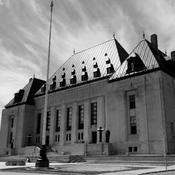
About Supreme Court of Canada Hearings (Floor Audio)
Unedited floor audio of oral arguments at the Supreme Court of Canada, i.e., in both English and French. Created as a public service to promote public access and awareness of the workings of Canada's highest court. Not affiliated with or endorsed by the Court. Original archived webcasts can be found on the Court's website at scc-csc.ca. Feedback welcome: podcast at scchearings dot ca.
Podcast websiteListen to Supreme Court of Canada Hearings (Floor Audio), The Tara Palmeri Show and many other podcasts from around the world with the radio.net app
Get the free radio.net app
- Stations and podcasts to bookmark
- Stream via Wi-Fi or Bluetooth
- Supports Carplay & Android Auto
- Many other app features
Get the free radio.net app
- Stations and podcasts to bookmark
- Stream via Wi-Fi or Bluetooth
- Supports Carplay & Android Auto
- Many other app features

Supreme Court of Canada Hearings (Floor Audio)
Scan code,
download the app,
start listening.
download the app,
start listening.
Supreme Court of Canada Hearings (Floor Audio): Podcasts in Family
 Canada - english