

Listen to this podcast in the app for free: Download for free in the App Store
radio.net
Sleep timer
Save favourites
History Matters by Canadian Institute for Historical Education
Canadian Institute for Historical Education
Latest episode
38 episodes
Jason Kenney on Western Alienation and the Alberta Referendum
2026-10-08 | 45 mins.Allan welcomes Jason Kenney, former Premier of Alberta, former federal cabinet minister, and spokesperson for the stay-in-Canada campaign, to discuss the upcoming referendum in Alberta and the deep historical roots of Western alienation. Prompted by the October 19th referendum, Kenney explores the origin of Alberta’s distinct political culture, the legacy of political dynasties like the United Farmers of Alberta (UFA), Social Credit and Progressive Conservatives, and key moments in federal-provincial tension—from early natural resource disputes to the National Energy Program and modern energy policy debates.Michael Hill on The Lost Prime Ministers
2026-10-01 | 42 mins.Allan welcomes guest Michael Hill, former history teacher, former artistic director of the Mariposa Folk Festival, and author of The Lost Prime Ministers: Macdonald's Successors Abbott, Thompson, Bowell, and Tupper, to discuss the four prime ministers who led Canada between the death of Sir John A. Macdonald and the election of Sir Wilfrid Laurier. Prompted by the recent unveiling of "The Unfortunate Four" sculpture in Bancroft, Ontario, Hill explores the unique backgrounds, political challenges, and brief tenures of John Abbott, John Thompson, Mackenzie Bowell, and Charles Tupper.Barbara Messamore on the King-Byng Affair
2026-09-24 | 42 mins.Allan welcomes back Barbara Messamore, Emeritus Professor of History at the University of the Fraser Valley, to discuss the 1925 Canadian federal election, the subsequent King-Byng affair, and the 1926 election. Messamore addresses common misconceptions regarding Governor General Julian Byng’s refusal of Prime Minister William Lyon Mackenzie King’s request for a dissolution of Parliament, examining how the crisis unfolded amidst the Customs Department scandal and Arthur Meighen’s short-lived government. She also reflects on the political dynamics between King and Meighen, the evolving constitutional role of the Crown in Canada, and how similar parliamentary situations have played out in Canadian political history.Barbara Messamore on Canada's 1921 General Election
2026-09-17 | 38 mins.Allan welcomes historian Barbara Messamore, Emeritus Professor of History at the University of the Fraser Valley, to discuss her book Times of Transformation: The 1921 Canadian General Election and the broader political landscape of post-WWI Canada. Messamore, who also serves as president of the Institute for the Study of the Crown in Canada, explores the rise of the Progressive Party, the political fortunes of leaders like Arthur Meighen and Mackenzie King and the historic election of Canada's first female MP Agnes MacPhail.John English on writing about Canada’s prime ministers.
2026-09-10 | 40 mins.Allan welcomes historian John English, Distinguished Professor Emeritus at the University of Waterloo, to discuss his long career of teaching and writing about Canadian history, and his significant contributions to public service. English edited two volumes of essays about Mackenzie King, published 25 years apart, and wrote critically acclaimed, two-volume biographies of both Lester Pearson and Pierre Trudeau. He also sat in the House of Commons himself from 1993 to 1997, wrote a report on the state of Canada’s national archives for then Heritage Minister Sheila Copps, and continues to serve as chair of the Canadian International Council.
More History podcasts




Trending History podcasts




About History Matters by Canadian Institute for Historical Education
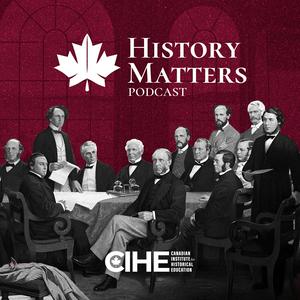
Canada’s history is full of triumphs, tensions, and turning points. Yet too often, it’s reduced to headlines or overshadowed by present-day debates. History Matters was created to give space for deeper conversations — ones that connect the past to the present, and help us see why context matters more than ever.
Podcast websiteListen to History Matters by Canadian Institute for Historical Education, Dan Snow's History Hit and many other podcasts from around the world with the radio.net app
Get the free radio.net app
- Stations and podcasts to bookmark
- Stream via Wi-Fi or Bluetooth
- Supports Carplay & Android Auto
- Many other app features
Get the free radio.net app
- Stations and podcasts to bookmark
- Stream via Wi-Fi or Bluetooth
- Supports Carplay & Android Auto
- Many other app features

History Matters by Canadian Institute for Historical Education
Scan code,
download the app,
start listening.
download the app,
start listening.
 Canada - english