

Listen to this podcast in the app for free: Download for free in the App Store
radio.net
Sleep timer
Save favourites
31 episodes
The Moonshot Mindset with Adam Savage and Sergey Brin
2026-06-03 | 52 mins.In this final and very special episode of Season Two of The Moonshot Podcast, we're zooming out on what it means to have a Moonshot Mindset, and how The Moonshot Factory has been systematizing radical innovation over the last 16 years.
We turn the tables, with Astro interviewed by TESTED host and king of experimental curiosity, Adam Savage, to talk about what innovation is, how you can really drive it, and how we can all be more innovative in our lives.
Next, Astro sits down with Google Co-Founder Sergey Brin, to discuss where the inspiration for The Moonshot Factory came from, and reflect on some of their favorite moonshots to date.
Learn more about your ad choices. Visit podcastchoices.com/adchoicesUnderground Potential
2026-05-27 | 18 mins.In this episode of The Moonshot Podcast we're diving deep—literally!—below the surface to uncover the ground's immense, untapped potential, which could unlock solutions to some of humanity's greatest challenges.
Astro sits down with Kathy Hannun from Project Dandelion to explore the breakthrough efficiency of geothermal heat pumps for home heating and cooling.
–
Hosted by Astro Teller, Captain of Moonshots, The Moonshot Podcast goes behind the scenes with creators and inventors trying to find radical solutions and breakthrough technologies to the world’s biggest problems. These are the untold stories of innovation from 16 years of Alphabet’s moonshot factory.
The Moonshot Podcast is a Pique Action production for X, The Moonshot Factory, produced in association with Blanchard House.
If you want to take your own moonshots, we've developed a certificate course with MasterClass on how to take bold ideas and translate them into real world impact. Check it out here: https://www.masterclass.com/certificates/breakthrough-innovation-strategy-from-bold-idea-to-business-impact
Learn more about your ad choices. Visit podcastchoices.com/adchoicesNeurons and Networks
2026-05-13 | 59 mins.This episode of The Moonshot Podcast explores what the mind can teach us about technology and how technology can help our minds.
First, Astro is joined by Sarah Laszlo from Project Valkyrie to discuss how looking at biological brains, such as that of a fruit fly, might unlock the key to more energy-efficient supercomputing.
Next, Astro speaks with Obi Felton who led project Amber, a moonshot that attempted to build a more affordable EEG device that could detect and measure mental health diseases like depression and anxiety.
–
Hosted by Astro Teller, Captain of Moonshots, The Moonshot Podcast goes behind the scenes with creators and inventors trying to find radical solutions and breakthrough technologies to the world’s biggest problems. These are the untold stories of innovation from 16 years of Alphabet’s moonshot factory.
The Moonshot Podcast is a Pique Action production for X, The Moonshot Factory, produced in association with Blanchard House.
If you want to take your own moonshots, we've developed a certificate course with MasterClass on how to take bold ideas and translate them into real world impact. Check it out here: https://www.masterclass.com/certificates/breakthrough-innovation-strategy-from-bold-idea-to-business-impact
Learn more about your ad choices. Visit podcastchoices.com/adchoicesThe Digital Trail
2026-05-06 | 50 mins.This episode of The Moonshot Podcast explores two ambitious moonshots focused on bringing "visibility" to the world's most complex and opaque digital and physical systems.
First, Astro is joined by Mike Wiacek, Stephen Gillett, and Shapor Naghibzadeh from Chronicle to discuss how they built a digital immune system for cybersecurity, using Google-scale data analysis to detect anomalous activity and combat a global economic threat.
Next, Astro speaks with Steven Chen and Suresh Vishnubhatla from Chorus, a moonshot focused on indexing the physical world to address monumental supply chain waste and inefficiency.
0:00 - Intro
01:25 - The "A-ha" moment that started Chronicle
03:35 - Rethinking the future of cybersecurity
05:17 - Building a "Digital Immune System"
11:35 - The terrifying scale of cyberattacks 10 years ago
13:08 - Understanding the 3 tiers of cybercriminals
15:46 - How Chronicle differed from other cybersecurity tools
19:27 - The “Coming Out” party: taking the tech public
21:12 - Returning to Google
23:23 - Memories and lessons learned from their time at X
24:53 - Enter Project Chorus: Meet Steven and Suresh
26:11 - Solving the supply chain’s biggest blind spot
29:41 - From idea to execution: How Chorus took flight
31:07 - What Chorus offers today
34:26 - A deep dive into the tech
36:46 - The evolution of Chorus
40:27 - How Chorus achieves “System-Wide” visibility
44:17 - Why every item in the supply chain matters
46:07 - Behind the scenes: Funniest project moments
47:28 - How Chorus could fundamentally change the world
48:55 - Final thoughts
–
Hosted by Astro Teller, Captain of Moonshots, The Moonshot Podcast goes behind the scenes with creators and inventors trying to find radical solutions and breakthrough technologies to the world’s biggest problems. These are the untold stories of innovation from 16 years of Alphabet’s moonshot factory.
The Moonshot Podcast is a Pique Action production for X, The Moonshot Factory, produced in association with Blanchard House.
If you want to take your own moonshots, we've developed a certificate course with MasterClass on how to take bold ideas and translate them into real world impact. Check it out here: https://www.masterclass.com/certificates/breakthrough-innovation-strategy-from-bold-idea-to-business-impact
Learn more about your ad choices. Visit podcastchoices.com/adchoicesSilicon Horizons
2026-04-29 | 36 mins.This episode of The Moonshot Podcast explores how X is reimagining computer chip design to power the next generation of AI.
Computer engineer Tammo Spalink joins host Astro Teller to discuss Project Positron and their radical decision to build "positronic brains" for robots that prioritize real-time response over raw throughput.
Astro then speaks with Raj Apte about Project Bodger, a moonshot that uses AI to design the hardware of the future. By moving away from traditional, hand-drawn architectures and toward "inverse design," the team explores how computers can create chips that are faster and more efficient than anything humans could design on their own.
Finally, the conversation looks toward the future of automated chip design and its role in accelerating Artificial General Intelligence (AGI). From personalizing healthcare to solving complex climate challenges, Astro and Raj discuss how these breakthroughs are ensuring the "silent, beating heart" of technology can keep up with our biggest ambitions.
Hosted by Astro Teller, Captain of Moonshots, The Moonshot Podcast goes behind the scenes with creators and inventors trying to find radical solutions and breakthrough technologies to the world’s biggest problems. These are the untold stories of innovation from 15 years of Alphabet’s Moonshot Factory.
The Moonshot Podcast is a Pique Action production for X, The Moonshot Factory, produced in association with Blanchard House.
Learn more about your ad choices. Visit podcastchoices.com/adchoices
More Documentary podcasts









Trending Documentary podcasts

About The Moonshot Podcast
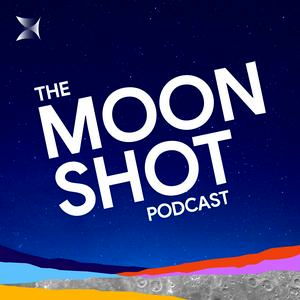
The Moonshot Podcast chronicles the untold stories of innovation - both highs and lows - from inside Google’s Moonshot Factory. In Season 2, Captain of Moonshots Astro Teller sits down with a new crop of moonshot takers exploring the next frontiers in health, biology, computing and more. From energy kites and robotic pants, to sea fuel and digital immune systems, go behind the scenes with the inventors and creators working to turn "what if" into what’s next.
Podcast websiteListen to The Moonshot Podcast, Sold a Story and many other podcasts from around the world with the radio.net app
Get the free radio.net app
- Stations and podcasts to bookmark
- Stream via Wi-Fi or Bluetooth
- Supports Carplay & Android Auto
- Many other app features
Get the free radio.net app
- Stations and podcasts to bookmark
- Stream via Wi-Fi or Bluetooth
- Supports Carplay & Android Auto
- Many other app features
The Moonshot Podcast
Scan code,
download the app,
start listening.
download the app,
start listening.
 Canada - english