

Listen to this podcast in the app for free: Download for free in the App Store
radio.net
Sleep timer
Save favourites
382 episodes
Why the World Has Always Been Weird — and Why That Matters
2026-09-14 | 18 mins.Uncle John's All-Knowing Bathroom Reader, Curiosity, and the Weirdness of Human History
Brian Boone joins the show to talk about why the world has always been weird—not just now. The conversation ranges from animal history and television oddities to fact-checking, collaboration, and why curiosity is the engine behind good stories and human wisdom. In this episode, Tricia and Brian Boone discuss how access to information can make the present feel stranger than the past, even though human behavior has always been full of surprises. They also explore the storytelling and editorial work behind Uncle John's All-Knowing Bathroom Reader, including how the team verifies claims, chooses topics, and turns obscure facts into accessible reading.
Key topics
Why the world has always been weird, even if modern media makes us more aware of it
Why dogs have so many breeds while cats have comparatively few
How horses helped shape agriculture, travel, trade, language exchange, and city states
Why fact-checking is more important—and more difficult—in an age of copied information
The story of J. Fred Muggs, the chimp who co-hosted Today in the early days of television
How risk-taking and strange ideas contribute to human innovation
Why fads are much older than mass media
How writers, editors, designers, and marketers collaborate on the bathroom reader
How colleagues' different passions can make unfamiliar subjects fascinating
Why curiosity may be the engine behind wisdom and connection
Timestamps
00:00
— Why the world feels weirder now than it used to
00:42
— The case for "the world has always been weird"
01:55
— Why cats have far fewer breeds than dogs
03:18
— How horses helped shape the modern era
05:23
— Why fact-checking is harder in an age of copied information
06:41
— The strange story of J. Fred Muggs on Today
08:42
— Why risk-taking and weird ideas are part of human progress
10:23
— Fads are older than mass media
12:51
— How the bathroom reader team collaborates
14:21
— Learning from coworkers with radically different interests
15:46
— Curiosity as the engine of wisdom
Learn more https://bathroomreader.com/From Super Bowl Champion to Literacy Champion | Malcolm Mitchell
2026-09-07 | 22 mins.What if readers and writers received the same attention, celebration, and investment as star athletes?
In this episode, Tricia speaks with Super Bowl champion, children's author, and literacy advocate Malcolm Mitchell about his new picture book, My Super Duper Me. They discuss the lasting effect of a few encouraging words, the role librarians can play in helping children see their own possibilities, and why adults should never underestimate the power of simply showing up with a positive message.
Malcolm shares his own journey from struggling reader to member of the Silverleaf Book Club, published author, and founder of Share the Magic Foundation. He explains why reading is not only an academic skill, but also a source of confidence, community, opportunity, and belonging.
The conversation also considers what schools and communities could learn from the cultural power of sports. If young people see athletes celebrated everywhere, how might their aspirations change if readers, writers, books, and libraries were made just as visible?
Malcolm also offers a candid look at his writing practice and the connection between athletic and creative training: show up, make the most of each repetition, and be willing to try again tomorrow.
In this episode:
• Why brief words of encouragement can stay with a young person
• The librarian at the heart of My Super Duper Me
• Malcolm's journey from struggling reader to passionate literacy advocate
• How a welcoming book club helped change his life
• Why reading can build confidence, connection, and belonging
• What it would mean to celebrate literacy as loudly as sports
• How educators can participate in free Share the Magic reading challenges
• What football taught Malcolm about writing, practice, and persistence
Learn more about Malcolm Mitchell, Share the Magic Foundation, and its free reading programs at readwithmalcolm.com.
We also talk about:
📚 Librarians as guides, bridges, and heroes
📚 Reading as a source of confidence, community, and belonging
📚 What schools can learn from the visibility and cultural power of sports
📚 Why creative practice is not so different from athletic training
📚 The willingness to show up and try againNever Underestimate a Young Reader
2026-08-31 | 28 mins.What do young people understand that adults mistakenly believe they have hidden from them?
Award-winning author Tiffany D. Jackson returns to the podcast to discuss Ghost in the Night, her haunting middle-grade novel set against the ghost tours, buried histories, and complicated beauty of Savannah, Georgia.
Tiffany invites educators to take young readers—and their capacity to confront difficult subjects—seriously. We explore why children sometimes attach themselves intensely to a particular interest while processing grief, and what educators might discover if they look beyond the fascination and ask what need it may be meeting.
We also discuss the importance of grief literacy, the trust created when adults acknowledge what children already know, and the difference between protecting young people and underestimating them.
The conversation moves beyond the ghosts of Savannah to examine whose histories become tourist attractions, whose stories remain untold, and how literature can inspire students to investigate the overlooked histories of their own communities.
Tiffany also shares why young characters need opportunities to form friendships without constant adult choreography, how she calibrates horror for middle-grade readers, and the deceptively simple practice she recommends to every aspiring writer: read closely enough to notice how a story works.
This episode explores:
Why educators need to take children's inner lives seriously
How intense interests can sometimes help young people process grief
The role of grief literacy in schools and classrooms
How honest conversations can build trust between adults and children
Why young people need agency in friendship and problem-solving
Whose histories are preserved, promoted, ignored, or buried
How place can function as a character in a novel
What horror offers middle-grade readers
How students can learn the craft of writing by reading like writers
At its heart, this conversation asks educators to consider what becomes possible when we stop assuming young people cannot handle the truth—and begin giving them stories that honour their intelligence, curiosity, and humanity.The Humanoid Robot, the Headlines, and What Really Happened
2026-08-28 | 57 mins.When Salamanca City Central School District announced plans to bring a humanoid robot into its robotics program, the story quickly became something else entirely: "A school is replacing teachers with robots."
That was never the plan.
In this episode, Jeff Utecht speaks with Superintendent Mark Beehler about what the district was actually trying to build—and what happened when an AI-generated image, alarming headlines, and social media outrage overtook the facts.
Mark explains how students helped shape the project, why the district saw the robot as an opportunity to explore emerging technology, and how a locally controlled AI platform could give students in an underserved rural community greater access to personalized academic support.
The conversation also examines a harder question: What does it cost a school leader to pursue responsible innovation when public fear moves faster than the truth?
You'll hear about:
Why Salamanca invested in a humanoid robot for its advanced robotics students
How students influenced its appearance, identity, purpose, and safeguards
The difference between the physical robot and the district's customized AI learning platform
How the technology was designed to scaffold learning—not provide answers or replace teachers
What happened when an AI-generated image distorted the story
Why even some edtech leaders helped spread the misinformation
How students who initially wanted AI banned became some of the project's most thoughtful contributors
The leadership lessons Mark learned about communication, control, and public trust
How the backlash gave him a new understanding of what young people experience when social media turns against them
This is not simply an episode about a robot. It is a candid conversation about educational risk-taking, media literacy, rural equity, and what it means to prepare students for a future that many adults are still struggling to imagine.Game Design Could Transform Assessment in the AI Era
2026-08-24 | 49 mins.What if students didn't simply complete an assessment—but designed an experience for someone else?
In this episode of Shifting Schools, Tricia Friedman pitches Jeff Utecht a new approach to assessment for the AI era: invite students to become game designers.
Games are memorable, social, challenging, and full of consequential choices. Designing one asks students to think about systems, understand an audience, establish meaningful constraints, gather feedback, solve problems, and defend the decisions they make. Those may be precisely the capabilities that matter most when AI can help produce a polished final product.
Tricia introduces the GAMES learning-design framework:
• Goal: What should players understand, practise, or accomplish?
• Audience: Who is the game being designed for?
• Mechanics: What rules, choices, and constraints make it work?
• Engagement: When do players experience agency, challenge, or frustration?
• Show It: How did testing and revision improve the game?
Check it out: https://shifting-schools-games.netlify.app/
Jeff and Tricia also explore how teachers and students can intentionally decide where AI belongs in the design process—and where the thinking should remain entirely human.
Along the way, they discuss centaur chess, systems thinking, authentic audiences, collaborative games, playtesting, vibe coding, and why assessment should increasingly examine a learner's judgment and reasoning rather than only the finished product.
You'll also hear about Bark Park, Tricia's AI-assisted dog-park simulator, where limited budgets, overflowing bins, rainy weather, unhappy visitors, and a neighbouring pickleball court turn one small public space into a surprisingly complex systems challenge.
In this episode:
• Why games often remain in our memories longer than individual lessons
• How game design develops systems thinking and executive function
• Why creating for a real audience builds empathy
• How playtesting makes feedback, failure, and revision feel natural
• What human-only and AI-supported stages might look like
• Why students need to explain and defend their design choices
• How AI can expand what students are capable of creating
• Why play may bring greater joy and meaning to assessment
Explore the GAMES framework, student design kit, research, standards connections, printable resources, and Bark Park through the links accompanying this episode.
We would love your feedback. Could this approach work in your classroom, course, or curriculum? Better yet, send us the unit you believe could never become a game. We would love to test the framework at its edges.
Thank you to our show sponsor: Unfurl
Learn more with Unfurl: https://unfurl.sh/
Connect with us:
Tricia Friedman: tricia@shiftingschools.com
General inquiries: info@shiftingschools.com
More Courses podcasts
 Platypus Economics with Justin WolfersBusiness, Courses, Education, Science, Social Sciences
 The Clinical Problem SolversEducation, Health & Wellness, Medicine, Science
 EconTalkCourses, Education, Philosophy, Science, Social Sciences, Society & Culture
 Learn Japanese with Masa sensei!Courses, Education
 T'as qui en Histoire ?Courses, Education, History
Trending Courses podcasts
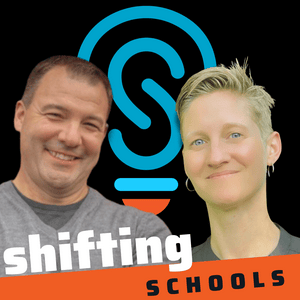
About Shifting Schools: Conversations for K12 Educators
Shifting Schools is a thought-provoking podcast that explores the latest trends, strategies, and tools in K-12 education. Hosted by educators Jeff Utecht and Tricia Friedman, the podcast provides a platform for teachers, administrators, and education thought leaders to share their experiences and insights on how to improve teaching and learning. From innovative approaches in classroom management to leveraging technology for personalized learning, Shifting Schools tackles the most pressing issues facing K12 educators today. Whether you are a seasoned teacher or a new educator, this podcast will inspire you to think outside the box and shift your educational approach. Tune in to Shifting Schools to gain new perspectives, share ideas, and join a community of passionate educators who are committed to making a positive impact in the lives of their students.
Follow us at @shiftingschools on Twitter and @shiftingschoolspod on Instagram and Tiktok
Podcast websiteListen to Shifting Schools: Conversations for K12 Educators, 高效磨耳朵 | 最好的英语听力资源 and many other podcasts from around the world with the radio.net app
Get the free radio.net app
- Stations and podcasts to bookmark
- Stream via Wi-Fi or Bluetooth
- Supports Carplay & Android Auto
- Many other app features
Get the free radio.net app
- Stations and podcasts to bookmark
- Stream via Wi-Fi or Bluetooth
- Supports Carplay & Android Auto
- Many other app features
Shifting Schools: Conversations for K12 Educators
Scan code,
download the app,
start listening.
download the app,
start listening.
 Canada - english