
Listen to this podcast in the app for free: Download for free in the App Store
radio.net
Sleep timer
Save favourites
146 episodes
The Dilemma Behind Debunking Trump | The Professor Is In
2026-10-27 | 19 mins.President Trump brags that he's brought $21 trillion in new investment into America. Justin Wolfers already debunked that number (the White House's own list only reaches $11.3 trillion), so in this office-hours episode he answers your questions about what that claim would even mean if it were true.
Subscribe:
on YouTube 👉 https://youtube.com/platypuseconomics
on Substack 👉 https://newsletter.platypuseconomics.com
the Podcast 👉 https://platypuseconomics.com/podcast
Follow on Social Media @PlatypusEconomics and @JustinWolfersWhat Is The State of Your Economy?
2026-10-25 | 50 mins.Why do strong economic numbers feel so bad? Justin Wolfers says there are three economies, not one.
Unemployment is 4.2%, the stock market is near a record, and GDP is growing — so why does your grocery bill, your rent, and your fill-up tell a different story? In this live call-in on NPR's The Middle with Jeremy Hobson, economist Justin Wolfers gives the economy three grades at once: an A if you own stock and a company, a B if you look at the lived reality of regular folks, and a C for how people actually feel — consumer sentiment at the lowest level ever recorded. The puzzle isn't a mystery, he argues: the share of Americans who think economic management is poor beats the share who think it's good by 66 points, an all-time high.
From Justin's conversation with Jeremy Hobson on NPR's The Middle, alongside CNBC's Steve Leisman.
Chapters:
Subscribe:
on YouTube 👉 https://youtube.com/platypuseconomics
on Substack 👉 https://newsletter.platypuseconomics.com
the Podcast 👉 https://platypuseconomics.com/podcast
Follow on Social Media @PlatypusEconomics and @JustinWolfersTrump Says $21 Trillion Is Coming. Is It? | Diving In
2026-10-24 | 20 mins.President Trump says he’s brought $21 trillion of new investment into America since taking office. Sometimes it’s $18 trillion, sometimes $22 trillion. The exact figure isn’t the problem. All of them are wrong, by a lot.
In this episode, Justin Wolfers gives you the questions you need to ask to test any huge number.
🎃 Enter our first-ever econ-themed Halloween costume contest by November 1 for a chance to win a limited-edition Gus the Platypus pillow: https://platypuseconomics.com/halloween
Subscribe:
on YouTube 👉 https://youtube.com/platypuseconomics
on Substack 👉 https://newsletter.platypuseconomics.com
the Podcast 👉 https://platypuseconomics.com/podcast
Follow on Social Media @PlatypusEconomics and @JustinWolfersWhy Americans Don't Believe the Good Economic News | The Professor Is In
2026-10-23 | 25 mins.Unemployment is low, inflation has cooled, and by most hard numbers the economy is doing okay — yet Americans sound miserable. Consumer sentiment this summer sat at 52, roughly where it was in May 1980, when unemployment was nearly twice as high and inflation was running around 14%. Justin Wolfers thinks he's cracked the puzzle: the 30-point gap between how you feel and how the economy is actually performing lines up almost exactly with how little Americans trust the people running economic policy right now.
In this office-hours episode, producer Augusta Chapman tries to poke holes in that story, and Justin defends it. Does the gloom cause the distrust, or the other way around? Does sentiment even matter if you keep spending anyway?
Subscribe:
on YouTube 👉 https://youtube.com/platypuseconomics
on Substack 👉 https://newsletter.platypuseconomics.com
the Podcast 👉 https://platypuseconomics.com/podcast
Follow on Social Media @PlatypusEconomics and @JustinWolfersDon’t Be Fooled by Trump’s Diesel Gimmicks | The Professor Is In
2026-10-21 | 26 mins.Tax-free red dye diesel won't make a single extra drop — so who really pays for it?
President Trump signed an executive order letting truckers fill up with red dye diesel — the cheaper, untaxed fuel normally reserved for tractors and bulldozers — and the White House says it'll save truckers about $60 a tank. In this "Professor Is In" episode, Justin Wolfers and producer Augusta Chapman take your questions and show why the tax-free diesel policy creates no new fuel at all. There's only so much diesel in the world, so every gallon truckers gain, farmers lose.
Subscribe:
on YouTube 👉 https://youtube.com/platypuseconomics
on Substack 👉 https://newsletter.platypuseconomics.com
the Podcast 👉 https://platypuseconomics.com/podcast
Follow on Social Media @PlatypusEconomics and @JustinWolfers
More Courses podcasts





Trending Courses podcasts
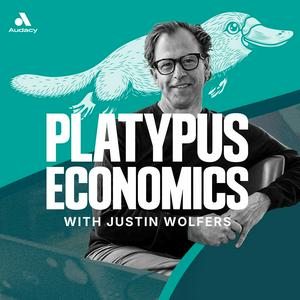
About Platypus Economics with Justin Wolfers
From world events to everyday decisions, economics explains it all. Platypus Economics makes it clear, useful, and actually fun.
Listen to Platypus Economics with Justin Wolfers, IELTSCast | Weekly shadowing exercises for IELTS Speaking and many other podcasts from around the world with the radio.net app
Get the free radio.net app
- Stations and podcasts to bookmark
- Stream via Wi-Fi or Bluetooth
- Supports Carplay & Android Auto
- Many other app features
Get the free radio.net app
- Stations and podcasts to bookmark
- Stream via Wi-Fi or Bluetooth
- Supports Carplay & Android Auto
- Many other app features

Platypus Economics with Justin Wolfers
Scan code,
download the app,
start listening.
download the app,
start listening.
 Canada - english