
Listen to this podcast in the app for free: Download for free in the App Store
radio.net
Sleep timer
Save favourites
23 episodes
Stubborn Facts about the Election of 1800
2026-09-30 | 1h 5 mins.In many ways the beginning of the musical Hamilton, is quite historically accurate. But to Sean, the precision gets loose… especially the election of 1800. So today Sean and Jay are here to set the record straight.
Start with James Madison, who isn't even in the capital in 1800; he'd retired to Montpelier. Then John Adams, whom the musical writes off entirely. Adams' New England base secured him against Hamilton's repeated attempts to dislodge him, and the race was far closer than the musical lets on, a few hundred votes in New York and he's re-elected. Hamilton, meanwhile, belonged to the High Federalist faction agitating for war with France; what Adams actually does in 1800 is negotiate the peace that infuriates them.
Aaron Burr had no separate faction either. He was a core Republican organizer who out-hustled Hamilton in New York City and helped build what became Tammany Hall. And when the Electoral College tied -an artifact of the pre-Twelfth Amendment ballot- it wasn't "up to Hamilton" to instruct anyone. It went to the lame-duck Federalist House, voting one vote per state, and took 36 ballots.The Perils of Predicting
2026-09-14 | 1h 4 mins.The midterms are in view, and Sean and Jay try not to treat the tea leaves like gospel. Although Jay got into the limelight through election blogging, he’s realized that it’s difficult to differentiate what he wants to happen and what will happen. This bias doesn’t just influence Jay but is ingrained in the practice of forecasting itself, making election predictions all the more difficult. Nevertheless, what politicians are doing now and how voters are feeling might give us a glimpse into November. Sean notes that unless you’re a wartime president or a great economy president, the ruling president will likely lose house seats, so we might see a wave of Blue representatives. The Senate? Only God knows for certain.Why Congress: An interview with Philip Wallach
2026-08-27 | 1h 5 mins.Our founders did not want all of American governance to diverge from England. In fact, the founders were inspired by Parliament's structure, which attempted to represent the desires of the people. Congress was perhaps well constructed but is not currently functioning well. As Wallach argues in his book, Congress is functioning well when the people trust that their interests are properly represented in the legislature. That trust and reciprocal relationship may not currently exist in spades. However, Wallach offers some potential solutions to not only empower better representation but also inspire Congress to pass bi-partisan legislation for the betterment of the whole country.
Wallach, Philip A. Why Congress. New York: Oxford University Press, 2023. https://www.amazon.com/Audible-Why-Congress/dp/B0C446NBP5
Remember to rate and follow Stubborn Things and stay up to date by following us on X @aei_STpodcast.
Comments? Suggestions? Email us at StubbornThings@aei.org.Presidential Tiers During a Liberal Turn
2026-08-03 | 1h 8 mins.From 1933 to 1953 we only had two presidents… So we naturally ranked them. When FDR came into office the country was looking bleak, there was a steady economic decline into the Great Depression that could have inspired a revolution. Instead, FDR maintains our democracy but grows the federal government like no other. Sean points how FDR was more moderate than perceived and Jay calls him a Wilsonian progressive but both see FDR as a defender of the republic. Following FDR, Truman "slips into place" as a wartime president but leaves with shockingly low approval ratings. However, Truman’s commitment to civil rights and strong opposition to communism may be his saving grace.
Remember to rate and follow Stubborn Things and stay up to date by following us on X @aei_STpodcast.
Comments? Suggestions? Email us at StubbornThings@aei.org.The Rise of the Kooks, the Fall of the Gatekeepers
2026-07-17 | 57 mins.Some kooks with sex scandals, securities fraud, and outlandish tweets are winning primaries and even congressional seats. Why are these ideological crackpots winning? And where are the party gatekeepers? On today’s podcast, Jay and Sean discuss how a centuries-long precedent of (primarily) electing the righteous is slowly falling prey to populism. In this podcast, our hosts discuss how the McGovern-Fraser Commission of 1968 may have increased democratic participation in primaries, but at the same time allowed political outsiders and some unique kooks to rise to power. Furthermore, the 1974 amendments to the Federal Election Campaign Act—although they limited the political power of rich donors—took power away from the parties to fund well-vetted candidates themselves.
Remember to rate and follow Stubborn Things and stay up to date by following us on X @aei_STpodcast.
Comments? Suggestions? Email us at StubbornThings@aei.org.
More Government podcasts







Trending Government podcasts
























About Stubborn Things
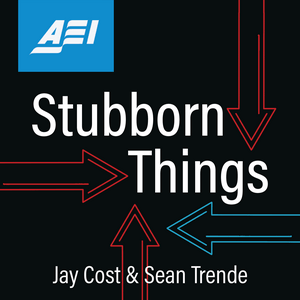
John Adams famously said: “Facts are stubborn things; and whatever may be our wishes, our inclinations, or the dictates of our passions, they cannot alter the state of facts and evidence." In this era of knee-jerk partisanship and ideological posturing, Adams's warning is as important as ever. Tune in every other week as AEI's Jay Cost and Sean Trende draw on their wide-ranging base of knowledge and stubborn commitment to the evidence to understand what is happening in the world of American politics.
Podcast websiteListen to Stubborn Things, What Trump Can Teach Us About Con Law and many other podcasts from around the world with the radio.net app
Get the free radio.net app
- Stations and podcasts to bookmark
- Stream via Wi-Fi or Bluetooth
- Supports Carplay & Android Auto
- Many other app features
Get the free radio.net app
- Stations and podcasts to bookmark
- Stream via Wi-Fi or Bluetooth
- Supports Carplay & Android Auto
- Many other app features

Stubborn Things
Scan code,
download the app,
start listening.
download the app,
start listening.
Stubborn Things: Podcasts in Family
 Canada - english