

Listen to this podcast in the app for free: Download for free in the App Store
radio.net
Sleep timer
Save favourites
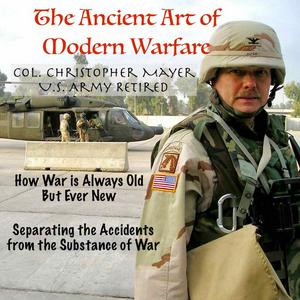
The Ancient Art of Modern Warfare
Chris Mayer National Security and Strategy Consultant
Latest episode
132 episodes

Is Just War Theory Obsolete? (E143)
2026-09-06 | 8 mins.Is Just War Theory still relevant to war and war fighting in the world today? Are the criteria of Just Cause, Right Intent, Legitimate Authority, and Proportionality, and Last Resort tools to restrain nations from going to war, or have these principles been twisted into excuses for going to war. This is part of the argument Pope Leo XIV makes in his recent Encyclical, Magnifica Humanitas, in which he is reported to say that Just War Theory is outdated. Is this true? If so, what does it mean? That is the subject of this episode of The Ancient Art of Modern Warfare.
References:
Leo XVI P.P., Magnifica Humanitas: On Safeguarding the Human Person in the Time of Artificial Intelligence, https://www.vatican.va/content/leo-xiv/en/encyclicals/documents/20260515-magnifica-humanitas.html
U.S. Department of Defense, The Department of Defense Law of War Manual (June 2015, Updated July 2023), https://media.defense.gov/2023/Jul/31/2003271432/-1/-1/0/DOD-LAW-OF-WAR-MANUAL-JUNE-2015-UPDATED-JULY%202023.PDF
Music: Wagner, R. and the USMC Band, Siegfried’s Funeral (Public Domain)Just War and Atom Bombs (E142)
2026-08-31 | 13 mins.Every August and September, the U.S. atomic bombing of Japan in 1945 seems to be a topic of discussion. This year, I decided to take that on and place it into the Just War framework, specifically jus in bello, or justice in the conduct of war. Just War Theory is a recurring topic in this podcast series. I believe that this framework is critical as a restraint on war and to establishing a just and lasting peace after war. (I still intend on addressing Pope Leo’s statement that Just War Theory is outdated.) This episode builds on information my guests and I presented in previous episodes, and particularly Episodes 13-16, and Episode 17 which described Just War Theory in theory and practice. As a side note, the web service that hosts these podcasts informed me that the episodes of the Ancient Art of Modern Warfare now have 50,000 downloads. I know that many podcasters get this for a single episode. Since I don’t do this for the clicks, but just to share my thoughts on war, I was somewhat impressed that so many people bothered to download my thoughts. Thank you.
Music:
Liszt, F., and the USMC Band, Les Preludes. Public Domain
Copland, A. & United States Marine Band. (2000) Fanfare for the Common Man. unpublished, Washington, DC. [Audio] Retrieved from the Library of Congress, (Fair use for educational purposes.)Is Hizballah a Mercenary Organization (E141)
2026-07-16 | 31 mins.The common definition of a mercenary is a soldier paid to fight in an armed conflict for a country that is not his or her own. The terrorist organization Hizballah operates in Lebanon, fighting against Israel, with financial, material and organizational support from Iran, and frequently under the direction of the Iranian Revolutionary Guard Corps. Under the common definition, could Hizballah be considered mercenaries fighting for Iran? Royce de Melo, Doug Brooks, and I discuss this question in this episode of the Ancient Art of Modern Warfare.
References:
Hague 1907: Convention (IV) respecting the Laws and Customs of War on Land and its annex: Regulations concerning the Laws and Customs of War on Land. The Hague, 18 October 1907. (definition of lawful combatant) https://ihl-databases.icrc.org/en/ihl-treaties/hague-conv-iv-1907
Article 47, Additional Protocol (I) to the Geneva Conventions, 1977 (definition of mercenary) (The United States is not a party to this Protocol) https://ihl-databases.icrc.org/en/ihl-treaties/api-1977?activeTab=1949GCs-APs-and-commentaries
United Nations Mercenary Convention: International Convention against the Recruitment, Use, Financing and Training of Mercenaries https://www.google.com/url?sa=t&source=web&rct=j&opi=89978449&url=https://www.ohchr.org/en/instruments-mechanisms/instruments/international-convention-against-recruitment-use-financing-and&ved=2ahUKEwi47cCQ6M-VAxV4M1kFHX_OGsAQFnoECA0QAQ&usg=AOvVaw1fCthlNI1AV0DjEGZmeTVl (As of the date of this episode, only 38 governments had ratified this treaty. Only two NATO countries are parties to the convention.)
Music:
Liszt, F., and the USMC Band, Les Preludes. Public Domain
Kiilstofte, P. Mercenaries, Machinamasound (Licensed)War Is Irrational (E140)
2026-06-17 | 10 mins.Is war rational? The great philosopher of war, Carl von Clausewitz, was a product of three schools of education: the classical tradition of Aristotle, the enlightenment philosophers such as Kant, and the practical experience of Napoleon. Each of these three challenged and opposed the other two. His work, On War expresses this tension and opposition. In his effort to develop a comprehensive theory of war, he had to deal with the many instances where the reality of war seemed to defy any coherent framework, where the things which should happen in war are contradicted by what actually happens. (This fits with his assigning the element of probability and chance to the military leg of his famous triad.) “Consequently,” he wrote, “it would be an obvious fallacy to imagine war between civilized peoples as resulting merely from a rational act on the part of their governments…” If it did, he concluded, then in the end, war would never need to be fought. But wars are fought. Is war itself then, irrational?
Music:
Traditional, The Army Strings, Garryowen (Public Domain)
Copland, A. & United States Marine Band. (2000) Fanfare for the Common Man. unpublished, Washington, DC. [Audio] Retrieved from the Library of Congress, (Fair use for educational purposes.)The Rational Actor Model (E139)
2026-06-09 | 10 mins.Since at least the 1940’s, policy and strategic thinking uses the so-called rational actor model in determining what competitors and partners may do, how to respond to them, and how they may react in return. Even considering variations to that model to explain less than optimal choices by these actors, there appears to be enough irrationality by state and non-state actors to call into question whether continued use of the rational actor model is itself rational.
Music:
Traditional, The Army Strings, Garryowen (Public Domain)
Copland, A. & United States Marine Band. (2000) Fanfare for the Common Man. unpublished, Washington, DC. [Audio] Retrieved from the Library of Congress, (Fair use for educational purposes.)
More Government podcasts
 The OShow with Laura BabcockGovernment, News, Politics, Society & Culture
 Optimist EconomyGovernment, Society & Culture
 5-4Government, News, News Commentary
 Strict ScrutinyGovernment, News, Philosophy, Society & Culture
 The DSR NetworkGovernment
 In-House – Canada's Housing PodcastEducation, Government
 The Lawfare PodcastGovernment, History, News, Politics
 The Jerry Agar ShowGovernment, News, Politics, Society & Culture
 PekingologyGovernment
 The InterviewGovernment, News, Politics
Trending Government podcasts
 Balade santéGovernment, Health & Wellness, Mental Health
 Leviathan Must Be StoppedGovernment
 OECD PodcastsGovernment
 DSR's Words MatterGovernment, News
 9/11: Two Decades LaterDocumentary, Government, News, Politics, Society & Culture
 State of PlayGovernment
 Red LinesGovernment
 No es el fin del mundoEntertainment News, Government, News
 Rethinking PalestineGovernment, News, News Commentary
 U.S. Supreme Court Oral ArgumentsGovernment
 The Debrief with Jon BeckerBusiness, Education, Government, Self-Improvement
 Question TimeGovernment, News
 The Development PodcastBusiness, Government, News, Non-Profit
 Democracy ParadoxGovernment, News, Politics, Science, Social Sciences
 Congressional DishGovernment, News, Politics
 Policing MattersGovernment
- In-House – Canada's Housing PodcastEducation, Government
 Law and ChaosGovernment, News, Politics
 Sask Ag Today on GX94Government
 Bourbon hebdo, les coulisses de l'AssembléeGovernment
 The Oath and The OfficeGovernment, News, Politics
 The Week in WestminsterGovernment
About The Ancient Art of Modern Warfare
Exploring changes in the practice of war while the fundamental nature and principles of war are unchanging. Includes mercenaries, PMSC, Hybrid Warfare, revolution in military affairs. For in-depth information see my blog at blog.ctmayer.net
Podcast websiteListen to The Ancient Art of Modern Warfare, The OShow with Laura Babcock and many other podcasts from around the world with the radio.net app
Get the free radio.net app
- Stations and podcasts to bookmark
- Stream via Wi-Fi or Bluetooth
- Supports Carplay & Android Auto
- Many other app features
Get the free radio.net app
- Stations and podcasts to bookmark
- Stream via Wi-Fi or Bluetooth
- Supports Carplay & Android Auto
- Many other app features

The Ancient Art of Modern Warfare
Scan code,
download the app,
start listening.
download the app,
start listening.
 Canada - english