
Listen to this podcast in the app for free: Download for free in the App Store
radio.net
Sleep timer
Save favourites
78 episodes
Great World Race Prep Update with Dr. Greg
2026-10-02This episode is less about extreme sport and more about rebuilding capacity. Greg explains why the easy work has mattered more than the hard work, why the boring fundamentals have made the biggest difference, and how small, consistent actions can turn something that once felt impossible into something that begins to feel achievable. Along the way, he invites listeners to think about their own version of “possible” and to use the 777 challenge as a spark for health, performance, and personal growth.All About Healthy Fats with Dr. Richard Bazinet
2026-08-21In today’s conversation Dr. Bazinet explores the science of healthy fats through the lens of brain biology, inflammation, cholesterol, and real-world nutrition. He and Dr. Wells unpack the differences between saturated, monounsaturated, and polyunsaturated fats, then dig into omega-3s, DHA, EPA, and why the brain’s relationship with fat is more fascinating than most people realize. They also discuss why the research on cardiovascular risk can be messy, why nutrition debates get oversimplified, and why a whole-food approach still makes the most practical sense. The result is a grounded, science-first conversation that brings clarity to one of nutrition’s most misunderstood topics.
You will learn how Dr. Bazinet distinguishes saturated, monounsaturated, and polyunsaturated fats; why DHA is such an important structural fat in the brain; how omega-3 and omega-6 pathways interact with inflammation; why the evidence on fish oil, cognition, depression, and heart health is more nuanced than social media suggests; and how to think practically about whole foods, fish, olive oil, grass-fed animal foods, and supplements. You will also hear why he remains careful about overclaiming in nutrition science, especially when randomized trials and observational data do not fully agree.
You will discover that one of the biggest mistakes in nutrition is talking about “fat” as though it is a single thing. Dr. Bazinet shows that the real story lies in the type of fat, where it comes from, what it replaces in the diet, and what question the research is actually able to answer.
This episode helps solve the challenge of trying to eat well in the middle of noisy, contradictory fat advice. Dr. Bazinet gives listeners a more intelligent framework for understanding fats so they can move beyond fear, hype, and internet certainty and make calmer, better food decisions.The Ripple Effect: Dr. Greg Wells’ Masterclass on on Healthy High Performance
2026-08-07In today’s conversation Dr. Greg Wells shares the core message of The Ripple Effect: if we want to feel better, think better, and perform at a higher level, we need to improve the fundamentals together. He explains how sleep, food, movement, and mental state amplify one another and why even small changes can create powerful downstream effects. The masterclass blends physiology, practical strategies, and real-world examples to show how healthier habits lead to better performance and a better life. At its heart, this is a science-based framework for turning potential into action.
You will learn why sleep is the foundation of recovery, energy, learning, and mood; how movement acts like medicine for the body and brain; how food quality influences energy, inflammation, and long-term health; why mindset and mental clarity affect every other behaviour; and how 1% improvements can build real momentum over time. You will also learn why dreams matter, how to turn knowledge into action, and how to stop chasing quick fixes in favour of sustainable habits that compound.
You will discover that health and performance are deeply interconnected. When you sleep better, you make better food decisions; when you move more, you think more clearly; and when you improve one part of the system, the others get stronger too.
This masterclass helps solve the challenge of knowing you want to feel better and perform better, but not knowing where to begin. Dr. Wells gives the listener a clear starting point: begin with one small, meaningful upgrade in sleep, eating, movement, or thinking, and let that improvement create a ripple effect through the rest of life.
Key take aways:
Sleep is the foundation of performance.
Movement is medicine for body and brain.
Food quality shapes energy and recovery.
Small changes create powerful momentum.
Health habits work best together.The Art of Finding Joy with Jessica Janzen
2026-07-24In today’s conversation Jessica Janzen explores how joy can become a deliberate practice even in the middle of grief, uncertainty, and pressure. She and Dr. Wells discuss the lived experience that shaped her work after the loss of her son Lewiston, and how that pain became the foundation for a new philosophy of resilience, service, and energy. The conversation moves from radical acceptance to practical tools for protecting mental health, choosing powerful thoughts, serving others, and creating moments of joy on purpose. It is a deeply human conversation about how to lead yourself well when life does not go to plan.
You will learn why Jessica believes joy is something we bring rather than simply choose, how radical acceptance creates the starting point for resilience, why brain health and mental health are tied to what we consume physically and emotionally, how movement and community can shift our internal state, and why service and simple acts of encouragement can change the emotional temperature of a room. You will also hear practical language she uses in real life, including how to challenge unhelpful thoughts, how to stop feeding negativity, and how to create more intentional energy in your day.
You will discover that joy is not passive, soft, or reserved for easier seasons. Jessica’s core insight is that joy becomes available when we stop waiting for circumstances to improve and start taking responsibility for the energy, thoughts, and actions we bring into the moment we are in.
This episode helps solve the challenge of feeling emotionally buried by stress, grief, burnout, or negative momentum. Jessica gives listeners a more usable framework for moving from victim energy and reactivity toward agency, perspective, connection, and meaningful action.Why I’m Doing The Great World Race (7 Marathons on 7 Continents in 7 Days) with my Daughter
2026-07-10In today’s conversation Dr. Greg explores the decision he and his sixteen-year-old daughter Ingrid made to attempt seven marathons on seven continents in seven days. He shares how persistent injuries led them to stop, recover, and rebuild their health from the ground up before they were ready to begin endurance training again. The episode traces the project from a series of small rehabilitation sessions to a potential Guinness World Record attempt, while introducing the Great World Race as a living exploration of human physiology, adaptation, and possibility. The event is scheduled for November 15–21, 2026, beginning at Wolf’s Fang in Antarctica and finishing in Miami.
More Education podcasts





Trending Education podcasts










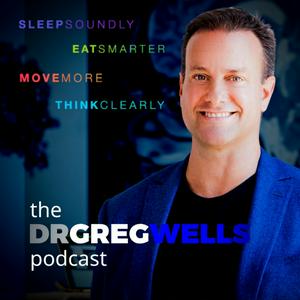
About The Dr. Greg Wells Podcast
Healthy High Performance for a Limitless Life
You can get healthier, improve your wellness, and live a limitless life and physiologist Dr. Greg Wells would love to be your trusted guide on that adventure.
Dr. Greg is one of the rare scientists who can take research and make it understandable so that you can have a clear path to achieving your goals.
In every episode, Dr. Greg and his expert guests will explain the science of how your body and brain work in a way that you can understand so you that you can get healthy, perform better, and live a limitless life.
Podcast websiteListen to The Dr. Greg Wells Podcast, All Ears English Podcast and many other podcasts from around the world with the radio.net app
Get the free radio.net app
- Stations and podcasts to bookmark
- Stream via Wi-Fi or Bluetooth
- Supports Carplay & Android Auto
- Many other app features
Get the free radio.net app
- Stations and podcasts to bookmark
- Stream via Wi-Fi or Bluetooth
- Supports Carplay & Android Auto
- Many other app features
The Dr. Greg Wells Podcast
Scan code,
download the app,
start listening.
download the app,
start listening.
The Dr. Greg Wells Podcast: Podcasts in Family
 Canada - english