

Listen to this podcast in the app for free: Download for free in the App Store
radio.net
Sleep timer
Save favourites
60 episodes
Leadership in Surgery: Trust, Culture, and Speaking Up with Dr. Paula Ferrada
2026-10-07 | 36 mins.What makes a good surgical leader—and what happens when people are afraid to speak up?
Dr. Paula Ferrada returns to Trauma ICU Rounds for a conversation about leadership in surgery, psychological safety, mentorship, and building teams that put patients first.
We begin with hemorrhage-first trauma resuscitation and the difficulty of challenging established practice, then explore how surgeons earn trust, respond to mistakes, support colleagues, and develop the next generation of leaders.
Topics include:
• Moving beyond blame and shame in surgical training and quality improvement
• Why leadership requires more than a title
• Finding mentors and supporting others as they advance
• Managing your own emotions under pressure
• Addressing gender bias and creating leadership opportunities
• Balancing decisive trauma team leadership with a culture of speaking up
• Approaching a struggling colleague with empathy
• Practical steps to become a better leader tomorrow
A conversation for surgeons, trainees, and anyone leading a team in trauma or critical care.
Resources:
The 5 Levels of Leadership — John C. Maxwell
Explore more episodes and educational resources:
https://www.traumaicurounds.ca
Follow Trauma ICU Rounds on your preferred podcast platform for future episodes.
Explore Trauma ICU Rounds:
https://www.traumaicurounds.ca
Follow:
Instagram: https://www.instagram.com/traumaicurounds
TikTok: https://www.tiktok.com/@traumaicurounds
YouTube: https://www.youtube.com/@traumaicurounds
Trauma ICU Rounds is intended for healthcare education. It does not replace clinical judgment, individualized patient care or local protocols.Shock: A Physiology-First Approach | Visual Rounds
2026-09-28 | 13 mins.This is a Visual Rounds episode — a more foundational crossover from the YouTube side of Trauma ICU Rounds.
Shock is not simply hypotension.
In this episode, we work through a physiology-first approach to shock: oxygen delivery, cardiac output, arterial oxygen content, MAP versus perfusion, compensated shock, mixed shock, and the four major shock states — hypovolemic, cardiogenic, obstructive, and distributive.
The goal is to move beyond simply naming a shock category and instead understand what part of the circulation is failing, what physiology is dominant, and how that should shape the first moves in resuscitation.
Topics include:
Recognizing shock before profound hypotension develops
Oxygen delivery: DO₂ = cardiac output × arterial oxygen content
Cardiac output, preload, contractility, and afterload
The importance of hemoglobin and oxygen-carrying capacity
MAP versus tissue perfusion
Compensated and mixed shock
Hypovolemic, cardiogenic, obstructive, and distributive shock
Initial resuscitation and mechanism-specific treatment
This episode is intentionally foundational and provides the framework for deeper Trauma ICU Rounds episodes on individual shock states and resuscitation.
If you find this kind of physiology-first critical care teaching useful, subscribe to Trauma ICU Rounds on YouTube for the full Visual Rounds series.
More resources: traumaicurounds.ca
Explore Trauma ICU Rounds:
https://www.traumaicurounds.ca
Follow:
Instagram: https://www.instagram.com/traumaicurounds
TikTok: https://www.tiktok.com/@traumaicurounds
YouTube: https://www.youtube.com/@traumaicurounds
Trauma ICU Rounds is intended for healthcare education. It does not replace clinical judgment, individualized patient care or local protocols.Whole Blood in Trauma Resuscitation: What Did TOWAR and SWiFT Change?
2026-09-08 | 18 mins.Whole blood has made a remarkable comeback in trauma resuscitation. Physiologically, the rationale is compelling, and observational studies have suggested improved survival. But the recent randomized TOWAR and SWiFT trials have challenged the assumption that whole blood is clearly superior to component therapy.
In this episode of Trauma ICU Rounds, we review the rationale for low-titer group O whole blood (LTOWB), the major observational data supporting its use, what TOWAR and SWiFT actually showed, and how these findings should influence contemporary damage-control resuscitation.
Topics include:
Low-titer group O whole blood (LTOWB)
Observational versus randomized evidence
TOWAR and SWiFT
Whole blood versus balanced component therapy
Integrating whole blood into massive hemorrhage protocols
Calcium, warming, TXA and hemorrhage control
RhD considerations in females of childbearing potential
The central question: whole blood clearly works as a resuscitation product—but is it actually better than excellent component therapy?
Full notes, graphics and references: traumaicurounds.ca
Follow @traumaicurounds on Instagram and TikTok, and subscribe on YouTube for new trauma and critical care teaching.
Explore Trauma ICU Rounds:
https://www.traumaicurounds.ca
Follow:
Instagram: https://www.instagram.com/traumaicurounds
TikTok: https://www.tiktok.com/@traumaicurounds
YouTube: https://www.youtube.com/@traumaicurounds
Trauma ICU Rounds is intended for healthcare education. It does not replace clinical judgment, individualized patient care or local protocols.State of the Rounds
2026-09-08 | 7 mins.After four years away, Trauma ICU Rounds is back.
In this short relaunch episode, I reflect on the journey from California back to Canada, how my clinical and leadership roles have evolved, and why now is the right time to return to the podcast.
We also share what comes next: clear, practical, evidence-informed conversations in trauma, critical care and resuscitation—designed to make complex topics easier to understand and apply at the bedside.
Welcome back to Rounds.
Explore Trauma ICU Rounds:
https://www.traumaicurounds.ca
Follow:
Instagram: https://www.instagram.com/traumaicurounds
TikTok: https://www.tiktok.com/@traumaicurounds
YouTube: https://www.youtube.com/@traumaicurounds
Trauma ICU Rounds is intended for healthcare education. It does not replace clinical judgment, individualized patient care or local protocols.Episode 54: Frailty, Geriatric Trauma & TBI with Dr. Bellal Jospeh
2022-09-20 | 47 mins.In this episode we sit down with the Chief of Trauma, Surgical Critical Care, Burns, & Acute Care Surgery at the University of Arizona, Dr. Bellal Joseph, who share with us his thoughts and research findings on hot topics including frailty, geriatric trauma, leadership, and more.
Timestamps:
00:12 Introductions
01:30 What is frailty? Your physiologic NOT chronologic body.
06:58 Injured elderly trauma patients can have good outcomes
07:30 Trauma specific frailty index
10:48 Failure to rescue
13:57 Geriatricians and the trauma surgeons
15:08 4Ms-What Matters, Mobility, Mentation, Medication
16:48 Geriatric cohorting/wards
22:24 ACS geriatric centers of excellence
29:35 Brain Injury Guidelines (BIG)
38:17 The importance of teamwork & servant leadership
40:28 Imposter syndrome
43:19 Leadership considerations
45:25 Final thoughts
References:
Joseph B, Friese RS, Sadoun M, Aziz H, Kulvatunyou N, Pandit V, Wynne J, Tang A, O'Keeffe T, Rhee P. The BIG (brain injury guidelines) project: defining the management of traumatic brain injury by acute care surgeons. J Trauma Acute Care Surg. 2014 Apr;76(4):965-9. doi: 10.1097/TA.0000000000000161. PMID: 24662858.
Joseph B, Obaid O, Dultz L, Black G, Campbell M, Berndtson AE, Costantini T, Kerwin A, Skarupa D, Burruss S, Delgado L, Gomez M, Mederos DR, Winfield R, Cullinane D; AAST BIG Multi-institutional Study Group. Validating the Brain Injury Guidelines: Results of an American Association for the Surgery of Trauma prospective multi-institutional trial. J Trauma Acute Care Surg. 2022 Aug 1;93(2):157-165. doi: 10.1097/TA.0000000000003554. Epub 2022 Mar 28. PMID: 35343931.v
Joseph B, Pandit V, Haider AA, Kulvatunyou N, Zangbar B, Tang A, Aziz H, Vercruysse G, O'Keeffe T, Freise RS, Rhee P. Improving Hospital Quality and Costs in Nonoperative Traumatic Brain Injury: The Role of Acute Care Surgeons. JAMA Surg. 2015 Sep;150(9):866-72. doi: 10.1001/jamasurg.2015.1134. PMID: 26107247.
Joseph B, Pandit V, Sadoun M, Zangbar B, Fain MJ, Friese RS, Rhee P. Frailty in surgery. J Trauma Acute Care Surg. 2014 Apr;76(4):1151-6. doi: 10.1097/TA.0000000000000103. PMID: 24662884.
Orouji Jokar T, Ibraheem K, Rhee P, Kulavatunyou N, Haider A, Phelan HA, Fain M, Mohler MJ, Joseph B. Emergency general surgery specific frailty index: A validation study. J Trauma Acute Care Surg. 2016 Aug;81(2):254-60. doi: 10.1097/TA.0000000000001120. PMID: 27257694.
Explore Trauma ICU Rounds:
https://www.traumaicurounds.ca
Follow:
Instagram: https://www.instagram.com/traumaicurounds
TikTok: https://www.tiktok.com/@traumaicurounds
YouTube: https://www.youtube.com/@traumaicurounds
Trauma ICU Rounds is intended for healthcare education. It does not replace clinical judgment, individualized patient care or local protocols.
More Education podcasts





Trending Education podcasts




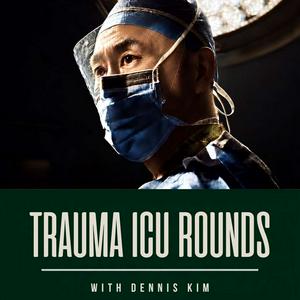
About Trauma ICU Rounds
Medical education podcast dedicated to providing high-quality, concise, and clinically relevant multimedia content spanning the spectrum of surgical critical care, emergency general & trauma surgery
Podcast websiteListen to Trauma ICU Rounds, Motivation Daily by Motiversity and many other podcasts from around the world with the radio.net app
Get the free radio.net app
- Stations and podcasts to bookmark
- Stream via Wi-Fi or Bluetooth
- Supports Carplay & Android Auto
- Many other app features
Get the free radio.net app
- Stations and podcasts to bookmark
- Stream via Wi-Fi or Bluetooth
- Supports Carplay & Android Auto
- Many other app features

Trauma ICU Rounds
Scan code,
download the app,
start listening.
download the app,
start listening.
 Canada - english
