
Listen to this podcast in the app for free: Download for free in the App Store
radio.net
Sleep timer
Save favourites
Technovation with Peter High (CIO, CTO, CDO, CXO Interviews)
Metis Strategy
Latest episode
300 episodes
Fix the Process Before the AI: Prakash Kota of UKG
2026-10-22 | 35 mins.AI layered onto a broken process doesn’t fix the process; it just runs it faster. Prakash Kota spent his first 18 months at UKG consolidating two legacy companies into unified CRM, ERP, and data systems before any AI conversation began. Now, as Chief Transformation Officer, he is shifting the question from “what tools can we deploy?” to “what outcome are we trying to reach?” That discipline extends to the customer funnel, where AI-assembled signals travel with a prospect through every handoff, and to sales reps, where an autonomous assistant pushes pre-meeting briefs before a rep has to ask, reclaiming the 40–50% of call-prep time currently spent on research.
Key Highlights:
Why redesigning the process must come before choosing the technology
How UKG unified two legacy companies’ systems as the foundation for AI-era work
The shift from AI as a tool you pull from to an autonomous teammate that pushes the right information to you
How AI-enriched signals travel with a prospect through every funnel handoff, making customers feel individually known
Why UKG’s CEO holds a weekly cockpit review of the top 10 transformation programs, measured at the business-outcome level
This episode is sponsored by Tines. This episode is presented by Tines: Freedom to build. Complete security. No compromises. Learn more at tines.ioAI Fluency Over AI Tools: Kristie Grinnell on Transforming TD SYNNEX
2026-10-19 | 34 mins.The binding constraint on AI adoption is not access to tools. It is the organizational fear and mindset shift required to reimagine work entirely.
In this episode of Technovation, Peter High speaks with Kristie Grinnell, EVP and Chief Information Officer at TD SYNNEX, about building company-wide AI fluency across a global workforce of nearly 30,000 employees.
Grinnell joined TD SYNNEX roughly two years ago and holds executive sponsorship of its AI fluency strategy alongside full IT operational scope. She describes how TD SYNNEX structured fluency at three tiers, required every ELT member to produce an AI plan, and built Fluidworks.ai as an internal factory to scale governed AI across the organization.
Key Highlights:
Why AI adoption fails as a change management problem before it fails as a technology problem
How a tiered fluency certification gives every employee a concrete path to AI readiness
Why every AI agent at TD SYNNEX must carry a registered identity and a named human owner
How agentic SOC triage turned tier-1 analysts into threat hunters
Why TD SYNNEX policy holds employees accountable for the AI outputs they use
This episode is sponsored by Tines. This episode is presented by Tines: Freedom to build. Complete security. No compromises. Learn more at tines.ioNo Pilot Graveyards: How Novant Health’s CAIO Turns AI Into Patient Outcomes
2026-10-15 | 33 mins.Healthcare has accumulated friction that patients have come to accept as normal. Novant Health’s Chief AI Officer is systematically dismantling it.
In this episode of Technovation, Peter High speaks with Vijay Sankararaman, Chief AI Officer at Novant Health, about deploying AI across patient experience, clinical operations, and proactive population outreach at a system with 22-plus hospitals and 8 million annual patient encounters.
Sankararaman came to healthcare from retail product and engineering leadership at Walmart and Lowe’s, and he brought a problem-first discipline with him: every AI initiative must justify the problem it solves before the technology is considered. His team has deployed a 24/7 surgical companion, a lung-cancer screening outreach program that contacted more than half of 20,000 at-risk patients in a fraction of the time human call programs managed, and a mammography scheduling agent that drove call abandonment to near zero.
Key Highlights:
Why the hardest part of a CAIO’s job is saying no to AI proposals
How a conversational AI agent reached thousands of at-risk lung-cancer patients human callers could not
What 40% after-hours engagement reveals about suppressed patient demand
Why the CEO’s frame on AI (technology feature vs. business reimagination) determines whether a CAIO role makes sense
How Novant’s build/buy/co-develop architecture avoids vendor lock-in without slowing deployment
This episode is sponsored by Tines. This episode is presented by Tines: Freedom to build. Complete security. No compromises. Learn more at tines.io95% AI Adoption: How Zoetis Built a Model-Agnostic Platform That Stuck
2026-10-12 | 31 mins.Most generative AI programs stall at the pilot stage. Zoetis reached 95% computer-based colleague adoption.
In this episode of Technovation, Peter High speaks with Keith Sarbaugh, Chief Digital and Technology Officer at Zoetis, about how the world’s leading animal health company built an AI platform that colleagues actually use, and how Sarbaugh measures whether any of it is working.
Sarbaugh spent over two decades in human pharmaceuticals at companies including Eli Lilly and Biogen before joining Zoetis in 2023. He now oversees IT, AI, data, cybersecurity, and global customer experience, and describes the role as more hybrid business-technology leader than traditional CIO.
Key Highlights:
Why Zoetis built a model-agnostic platform (Zen AI) with 10–11 LLMs rather than standardizing on one
How a 350-person global Change Champion Network drove adoption faster than any top-down mandate
What Sarbaugh’s Business Value Realization Framework requires teams to define before a project begins
Where agentic AI earns its place: rules-based, high-value decisions like supply chain demand forecasting
Why aggregating all customer touchpoints at 10x prior volume revealed service failures that NPS never could
This episode is sponsored by Tines. This episode is presented by Tines: Freedom to build. Complete security. No compromises. Learn more at tines.ioLior Susan on Why Now Is the Time to Build Industrial Giants
2026-10-09 | 27 mins.The next generation of technology giants may not be built in software. They may be built in factories.
In this episode of Technoventure, Peter High speaks with Lior Susan, Founder and Managing Partner of Eclipse, about why AI, robotics, and industrial innovation are transforming the economics of American manufacturing.
Lior explains Eclipse’s five-forces framework for building industrial companies and why physical industries represent a significant opportunity for venture capital.
They explore:
How AI and robotics enable competitive domestic manufacturing
Why industrial startups need operating expertise beyond capital
The infrastructure opportunities emerging from AI’s energy and compute demands
Why humanoid robotics may be getting ahead of practical applications
How policy and national security are shaping industrial investment
Listen to discover why Lior believes this is an extraordinary moment to build companies in the physical world.
More Business podcasts







Trending Business podcasts











About Technovation with Peter High (CIO, CTO, CDO, CXO Interviews)
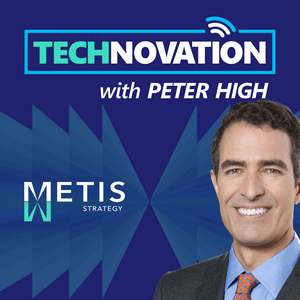
Twice-weekly conversations with top executives and thought leaders at the intersection of business, technology, and innovation. Each episode of Technovation explores the technology trends that are transforming business, and the leaders driving digital change inside their organizations. Produced by Metis Strategy and hosted by firm President Peter High, Technovation is the premier podcast for IT and technology professionals with the largest collection of interviews with elite CIOs, CTOs, and CDOs.
Podcast websiteListen to Technovation with Peter High (CIO, CTO, CDO, CXO Interviews), The Loonie Hour and many other podcasts from around the world with the radio.net app
Get the free radio.net app
- Stations and podcasts to bookmark
- Stream via Wi-Fi or Bluetooth
- Supports Carplay & Android Auto
- Many other app features
Get the free radio.net app
- Stations and podcasts to bookmark
- Stream via Wi-Fi or Bluetooth
- Supports Carplay & Android Auto
- Many other app features
Technovation with Peter High (CIO, CTO, CDO, CXO Interviews)
Scan code,
download the app,
start listening.
download the app,
start listening.
 Canada - english