
Listen to this podcast in the app for free: Download for free in the App Store
radio.net
Sleep timer
Save favourites
The CopDoc Podcast: Aiming for Excellence in Leadership
Dr. Steve Morreale - Host - TheCopDoc Podcast
Latest episode
179 episodes
Brandon Gurley, Brookhaven Police, GA
2026-09-23 | 52 mins.The CopDoc Podcast - Season 11 - Episode 177
Leadership Culture Under Pressure with Chief Brandon Gurley
Dr. Steve Morreale talks with Chief Brandon Gurley of Brookhaven Police Department about the career path that shaped his leadership, from dispatcher and detention officer to chief of a fast-growing agency near Atlanta. The conversation centers on how early frontline experience, intentional culture-building, and curiosity-driven leadership can improve policing outcomes.Gurley also shares how Brookhaven Police Department was built from the ground up, how he approaches command staff meetings, and why he believes policing often promotes technical experts instead of true people leaders.
Key topics
In this episode, Chief Brandon Gurley shares how starting as a 911 call taker and detention officer gave him an early understanding of stress, communication, and de-escalation.
He explains his move from Paulding County Sheriff’s Office to Sandy Springs, then into the startup of Brookhaven Police Department when the city incorporated in 2012.
Gurley describes the challenge of helping build a brand-new agency, including hiring 54 sworn officers from 26 different metro-area agencies.
He discusses why public information work, recruiting, and background investigations became important parts of his development as a future chief.
He draws a clear distinction between police administration and police leadership, arguing that leadership requires vision, accountability, and the willingness to do the work alongside others.
Gurley says technical competence alone is not enough for promotion, and that many leadership failures happen when agencies elevate the best performer instead of the best people leader.
He explains how Brookhaven uses committees, strategic planning, and weekly command staff meetings to turn ideas into actionable outcomes.
He talks about leading through questions, staying curious, and helping others solve their own problems instead of constantly fixing them himself.
Gurley reflects on Brookhaven’s community engagement in a large Hispanic population area, including Officer Nino’s outreach work and the department’s Spanish-speaking Citizens Police Academy.
He shares why culture is harder to change than policy, and why training only matters if the organization’s culture can support what people learn.
Notable quotes
“Culture by design.”
“Curiosity is a growing skill set.”
“A great police leader is someone who listens to understand before they listen to respond.”
Hey there! Send us a message. Who else should we be talking to? What topics are important? Use FanMail to connect! Let us know!
Contact us: copdoc.podcast@gmail.com
Website: www.copdocpodcast.com
If you'd like to arrange for facilitated training, or consulting, or talk about steps you might take to improve your leadership and help in your quest for promotion, contact Steve at stephen.morreale@gmail.comCulture Starts With Listening - Chief Doreen Jokerst, Ed.D., Overland Park Police KS
2026-09-08 | 54 mins.The CopDoc Podcast - Season 11 - Episode 176
Dr. Doreen Jokerst on culture, leadership, and modern policing in Overland Park
Dr. Doreen Jokerst, chief of police in Overland Park, Kansas, joins Steve Morreale for a conversation about leadership, culture, technology, and what it means to build trust inside a police organization and with the community. She shares how her path through city policing, university policing, and doctoral study shaped a leadership style rooted in curiosity, collaboration, and accountability.We discuss how she uses listening sessions, transparent communication, and thoughtful technology governance to strengthen legitimacy, support officers, and improve service. This episode is especially relevant for leaders thinking about culture change, talent development, and the future of policing.
Key topics
Dr. Doreen Jokerst shares how Overland Park Police Department serves a city of about 207,000 residents, with 270 authorized police officers and 85 professional staff
She traces her path into policing back to age 8, when a visit to Alcatraz helped spark a lifelong interest in helping people
She explains the value of university policing at CU Boulder, where she learned to work across different perspectives and saw public safety through a broader lens
She describes culture as something you can feel, comparing it to a sailboat in the wind and emphasizing that leaders must listen before trying to change anything
She says insatiable curiosity breeds innovation, and that asking why systems exist is essential to understanding an organization without disrupting what already works
She details her listening-session approach, including writing down names, tracking themes, following up personally, and making sure people see action after they speak
She emphasizes explaining the why, whether in organizational decisions or even traffic stops, because legitimacy grows when people understand the reason behind an action
She discusses thoughtful technology adoption, including DFR, real-time information centers, data dashboards, and ALPR, with transparency and governance controls
She explains why she values psychologically safe spaces, where staff at every level can challenge ideas and contribute to better decisions
She makes the case for mentorship and continuity, saying leaders should develop successors so agencies do not feel like they are starting over every time leadership changes
She connects culture and service, saying that if leaders treat people poorly inside the department, that behavior will show up in community interactions too
She highlights the importance of representation and 30 by 30, noting that women remain underrepresented in policing and that hiring should reflect both diversity of thought and community identity
She argues that success metrics must evolve, moving beyond arrests and citations toward data that better reflects harm reduction, trust, engagement, and problem-solving
She describes her management style as coaching and stewardship, with clear expectations, regular check-ins, and delegation that still leaves people feeling supported
She closes with optimism about the future of policing, saying the profession is honorable and that she wants to keep showing up like it is her first day
Hey there! Send us a message. Who else should we be talking to? What topics are important? Use FanMail to connect! Let us know!
Contact us: copdoc.podcast@gmail.com
Website: www.copdocpodcast.com
If you'd like to arrange for facilitated training, or consulting, or talk about steps you might take to improve your leadership and help in your quest for promotion, contact Steve at stephen.morreale@gmail.comRank Gives You Authority. It Doesn't Make You a Leader, Chris Hsiung, Executive Director - The Curve
2026-08-27 | 55 mins.The CopDoc Podcast - Season 10 - Episode 175
GUEST: Chris Hsiung, Undersheriff, San Mateo County Sheriff's Office, and Executive Director, The Curve
EPISODE SUMMARY:
Rank does not make a leader. That is the premise Chris Hsiung and I worked through in this conversation, and it shapes everything else we talked about.
Chris has spent more than 30 years in policing, most of it with the Mountain View Police Department, where he rose from patrol officer to chief. He now serves as Undersheriff with the San Mateo County Sheriff's Office and leads The Curve, a nonprofit he co-founded with Simon Sinek to help police leaders build cultures grounded in trust and purpose. We talked about what it actually takes to change a department's culture, and why that work starts with what leaders do, not what they say.
Chris put it simply: culture equals values plus behavior. A lot of agencies have values painted on the wall and printed on the cruiser. Few agencies have leaders whose daily behavior matches those words. We got into what happens when that gap goes unaddressed, why leaders need people who will tell them the truth instead of what they want to hear, and how Chris learned to lead by taking off the stars and getting into the jail, onto the ride-along, into the training room, alongside the people he was asking to trust him.
This one is for chiefs, sheriffs, sergeants, and anyone tired of waiting for a promotion before they start leading.
KEY TOPICS DISCUSSED:
Why rank grants authority but not leadership, and the difference between the two
Culture by design versus culture by default, and what happens when leaders leave culture to chance
How to build change from the middle of an organization by working with early adopters instead of trying to convince everyone at once
Why "everything is green" reporting should worry a leader more than it comforts one
What it means to get out of the office: riding along, training with your people, learning the job from the ground up
How Chris's own mistakes and uncertainty as a young leader shaped the leader he became
Why a healthy culture is one of the strongest recruitment and retention tools an agency has
INSIGHTS FROM THE CONVERSATION:
Chris made a case that leadership starts long before anyone pins on a badge or a stripe. Waiting for the title is the wrong strategy. He also pushed back on the idea that a leader can understand an organization from behind a desk. His answer to reading an agency's real condition was blunt: go find out for yourself, in person, without the rank showing.
On trust, Chris was direct about the danger of an organization where nobody tells the boss bad news. If every report comes back green, that is not evidence things are fine. It is often evidence people are afraid to say otherwise, and a leader steering by false readings will not see the iceberg coming.
He closed with a simple answer to a hard question: what should policing never stop doing? Caring. Everything else in this conversation, the culture work, the trust building, the willingness to admit mistakes, comes back to that one word.
KEY TAKEAWAYS FOR LISTENERS:
Audit the gap between your agency's stated values and your own daily behavior. That gap is your culture, whether you intended it or not.
Do not try to convince the whole organization at once. Find your early adopters and let their results do the persuading.
If everyone tells you things are fine, ask why. Build channels where people can safely tell you when they are not.
Spend time outside your office, in uniform-optional settings, doing the work your people do. You cannot lead what you do not understand.
Treat your own mistakes and uncertainty as material, not liabilities. Vulnerability, handled honestly, builds more trust than the appearance of having it all figured out.
ABOUT CHRIS HSIUNG:
Chris Hsiung currently serves as Undersheriff with the San Mateo County Sheriff's Office, a role he stepped back into in November 2025 to support Sheriff Ken Binder during a period of organizational rebuilding. He is a retired police chief with more than 30 years of public safety experience in the San Francisco Bay Area, most of it with the Mountain View Police Department, where he worked as a detective and SWAT team member before being appointed chief in 2020.
Chris is a founding board member and Executive Director of The Curve, a national nonprofit he co-founded with Simon Sinek and a network of police chiefs and sheriffs to modernize leadership development in policing. He co-chairs the IACP Human and Civil Rights Committee and holds board advisory roles with the University of Virginia Center for Public Safety and Justice, the Future Policing Institute, and the Crisis Ready Institute. He is a nationally recognized speaker and writer on organizational culture and adaptive leadership.
RESOURCES MENTIONED:
The Curve (thecurve.org)
Hey there! Send us a message. Who else should we be talking to? What topics are important? Use FanMail to connect! Let us know!
Contact us: copdoc.podcast@gmail.com
Website: www.copdocpodcast.com
If you'd like to arrange for facilitated training, or consulting, or talk about steps you might take to improve your leadership and help in your quest for promotion, contact Steve at stephen.morreale@gmail.comTerry Dwyer, J.D. Professor - Western CT State University, NYSP (Retired)
2026-07-21 | 52 mins.The CopDoc Podcast - Season 10 - Episode 174
Guest: Terry Dwyer, J.D. – Professor, Author, & Playwright
In this episode, Dr. Steve Morreale sits down with Terry Dwyer, J.D., a professor at Western Connecticut State University and a retired New York State Police investigator. Terry shares insights from his diverse career stretching across the Navy Reserves, corrections, the court system, state policing, legal practice, and creative writing. They dive deep into the differences between leadership and management, police culture, systemic issues facing women in law enforcement, and the trauma that impacts officers and their families.
Key Takeaways
The Foundations of Corrections: Terry strongly believes every police officer should spend time working in corrections first. It builds crucial, real-world communication and de-escalation skills by forcing you to manage difficult situations entirely with your words.
Leadership vs. Micromanagement: A disturbing shift in modern policing culture is the rise of the "liability-first" mindset. Exceptional supervisors lead by establishing trust and giving their professionals autonomy, whereas poor managers default to punitive micromanagement and "dog-piling" charges onto struggling officers.
Secondary Trauma & The Family Unit: Law enforcement trauma isn't just about active gunfights; it is cumulative. Terry emphasizes that the true partner riding through the career's highs and deep lows with an officer is their spouse, highlighting his 42-year marriage to his wife, Joan.
Culture and the 30x30 Initiative: Discussing his background representing female officers in harassment suits, Terry notes that police culture can be intensely insulated. He underscores the importance of the 30x30 Initiative (aiming for 30% women in policing by 2030) and notes that a department's culture is purely dictated by its top leadership.
Featured Works by Terry Dwyer
Book: The Badge Between Us: Duty, Marriage, and Family – Part memoir, part true crime, and part love letter to his wife, exploring the unseen weight a police family carries.
Play: Depositions – An MFA thesis play premiered at the Grand Fringe Festival, based on his qualitative research and legal cases surrounding sexual harassment and the experiences of female police officers.
Upcoming Project: A true-crime book detailing a 50-year-old cold case involving a missing young Black man whose remains were finally identified in 2024, focusing on a dedicated detective who investigated it into his retirement.
Hey there! Send us a message. Who else should we be talking to? What topics are important? Use FanMail to connect! Let us know!
Contact us: copdoc.podcast@gmail.com
Website: www.copdocpodcast.com
If you'd like to arrange for facilitated training, or consulting, or talk about steps you might take to improve your leadership and help in your quest for promotion, contact Steve at stephen.morreale@gmail.comDr. Robin Engel, Ohio State University
2026-07-07 | 58 mins.The CopDoc Podcast - Season 10 - Episode 174
Unlock the secret to transforming police leadership from the front lines. Dr. Robin Engel shares how dedicated research and real-world experience are reshaping police training and community trust—yet the journey is anything but easy.
In this powerful conversation, Robin reveals how her personal history fuels her relentless drive to improve policing—highlighting pivotal moments like her role in Cincinnati’s reform after a tragic officer-involved shooting. You’ll discover her innovative approach to data-driven policing, the critical importance of first-line supervisors, and why understanding and empowering the backbone of police organizations can prevent crises before they happen.
We break down:
How accreditation standards and evidence-based practices guide meaningful reform
The role of a national consortium, CAPS, in strengthening frontline supervision across diverse agencies
Why a police officer’s most vital asset is the support from their superior, and how training gaps undermine safety and morale
The surprising insights from body cam analysis, AI, and administrative data that actually improve decision-making in the field
Robin’s leadership lessons on uniting community, academia, and police during moments of crisis
There’s a stark warning here: neglecting frontline supervisors and evidence-based strategies leaves departments vulnerable to the chaos of the next crisis. Conversely, building a culture of continuous learning and local leadership means resilient, safer communities. Robin’s heartfelt story of overcoming skepticism and her unwavering commitment to impactful reform is an essential listen for anyone determined to make policing better.
Perfect for police officers, administrators, researchers, and community advocates eager to innovate and bridge the divide between theory and practice. Robin Engel, a renowned professor at Ohio State University and a leader in policing reform, exemplifies the power of knowledge turned into action, making this episode a vital blueprint for meaningful change.
Hey there! Send us a message. Who else should we be talking to? What topics are important? Use FanMail to connect! Let us know!
Contact us: copdoc.podcast@gmail.com
Website: www.copdocpodcast.com
If you'd like to arrange for facilitated training, or consulting, or talk about steps you might take to improve your leadership and help in your quest for promotion, contact Steve at stephen.morreale@gmail.com
Hey there! Send us a message. Who else should we be talking to? What topics are important? Use FanMail to connect! Let us know!
Contact us: copdoc.podcast@gmail.com
Website: www.copdocpodcast.com
If you'd like to arrange for facilitated training, or consulting, or talk about steps you might take to improve your leadership and help in your quest for promotion, contact Steve at stephen.morreale@gmail.com
More Education podcasts





Trending Education podcasts













About The CopDoc Podcast: Aiming for Excellence in Leadership
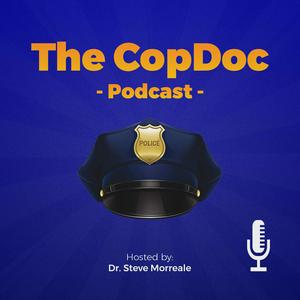
Visit our website: https://www.copdocpodcast.com The CopDoc Podcast delves into police leadership and innovation. The focus is on aiming for excellence in the delivery of police services across the globe. Dr. Steve Morreale is a retired law enforcement practitioner, a pracademic, turned academic, and scholar from Worcester State University. Steve is the Program Director for LIFTE, Command College - The Leadership Institute for Tomorrow's Executives at Liberty University. Steve shares ideas and talks with thought leaders in policing, academia, community leaders, and other related government agencies. You'll find Interviews with thought leaders drive the discussion to improve police services and community relationships.Happy to report that The CopDoc Podcast is listed as #4 in the 10 Best Worcester Podcasts! https://podcast.feedspot.com/worcester_podcasts/
Podcast websiteListen to The CopDoc Podcast: Aiming for Excellence in Leadership, Hugo Girard - Sans Limite and many other podcasts from around the world with the radio.net app
Get the free radio.net app
- Stations and podcasts to bookmark
- Stream via Wi-Fi or Bluetooth
- Supports Carplay & Android Auto
- Many other app features
Get the free radio.net app
- Stations and podcasts to bookmark
- Stream via Wi-Fi or Bluetooth
- Supports Carplay & Android Auto
- Many other app features

The CopDoc Podcast: Aiming for Excellence in Leadership
Scan code,
download the app,
start listening.
download the app,
start listening.
 Canada - english