

Listen to this podcast in the app for free: Download for free in the App Store
radio.net
Sleep timer
Save favourites
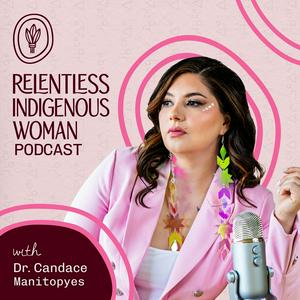
Relentless Indigenous Woman Podcast
Relentless Indigenous Woman
Latest episode
63 episodes
Ep. 63: From Embroidery to Empire: The Power of Starting Small in Entrepreneurship with Michelle Cameron
2026-07-22 | 54 mins.Ever feel like you need the perfect plan before starting your business?
In this episode of Relentless Indigenous Woman, Dr. Candace Manitopyes welcomes Michelle Cameron, CEO of Dreamcatcher Promotions, to talk about the messy, real, and rewarding path of Indigenous entrepreneurship.
From their hilarious first meeting stuck in a blizzard-bound minivan in Northern Ontario to Michelle building a multi-million dollar company with nothing but a used embroidery machine and YouTube tutorials, they discuss how you don't need perfection to start, you just need the drive to change your life.
The two dig deep into breaking the "poverty mindset," the importance of seeking help through Indigenous Financial Institutions (IFIs) for business planning, and why true luxury is a calm nervous system and time with family.
If you’ve been letting fear or shame hold you back from your vision, this conversation is your sign to keep going. Tune in to learn why you deserve to thrive, how to stop trying to do everything yourself, and why "Growth Valley" is where your biggest breakthroughs happen.
Relentless Actions
Outsource the "Scary" Parts: If "business plan," "taxes," or "finances" are stopping you from starting, stop forcing yourself to do it alone. Seek out your local Indigenous Financial Institution (IFI); they often have programs that provide funding specifically to hire consultants who can write business plans and handle financial setup for you.
Audit Your "Spending vs. Investing": Take a hard look at your current money habits. If you are struggling with a "poverty mindset" where money disappears as soon as it arrives, try starting small by setting aside even a minimal amount (like $100/month or a percentage of income) into a "slush fund" or savings account to build a buffer. Practice shifting from impulsive spending to intentional investing in your own business growth.
Relentless Reflections
Redefine "Growth Valley" vs. "Death Valley": While the first five years of business are often called "Death Valley" due to high failure rates, view them instead as "Growth Valley." This phase is a crucible for your own personal development. It will force you to become more innovative, brave, and honest about what is—and isn't—working in your venture.
Wealth is More Than Material: Colonization has distorted our relationship with luxury. True luxury is not just material possession; it is a calm nervous system, the ability to trust your relationships, having time for your family, and the freedom to contribute back to your community. When you ground yourself in these values, you become a more resilient and effective entrepreneur.
Resources
Indigenous Financial Institutions (IFIs): These organizations are essential for Indigenous entrepreneurs. They provide not just capital, but often access to "aftercare" programs and consultants who can teach you financial literacy and business planning. Look for your regional IFI, such as the First Peoples Economic Growth (Manitoba) or similar entities in your province.
Dreamcatcher Promotions: Indigenous-owned and trusted nationwide, we create custom branded merchandise and apparel that reflects your organization’s identity and supports your goals https://www.dreamcatcherpromotions.ca/
Send Us a Text with Your Thoughts or Questions!
Join the RIW Patreon Community
RIW Website
Music Produced by Award-Winning Anishnaabe DJ Boogey the BeatEp. 62: The Art of Unforgetting: How Land-Based Wisdom Rewires the Western Mind with Patty Krawec
2026-07-15 | 59 mins.What if the very tools we use to understand history (time, progress, and even language) are the exact things preventing us from achieving true collective liberation?
In this episode, Dr. Candace Manitopyes welcomes author and speaker Patty Krawec to discuss the profound necessity of "unforgetting." They dismantle the myth that Diversity, Equity, and Inclusion (DEI) initiatives are sufficient, arguing that without a fundamental shift in how we relate to the Land and each other and history, we are simply building a larger, more inclusive colonial tent.
Patty shares how Anishinaabemowin and other process-oriented, Land-based ways of knowing offer a radical alternative to the Western, noun-based, and time-obsessed worldview. They explore why our stories, science, and sense of self are inextricably linked to place, and why we must move from passive consumption of information to intentional, capacity-based action. This is an invitation to stop "dunking" on each other on social media and start building webs of knowledge that actually sustain our communities.
Relentless Actions
The Capacity Audit: Stop "rage-posting" and start organizing. When you feel triggered by an injustice, don't let it paralyze you. Instead, adopt the framework discussed in the episode: Ask yourself four questions: What can I learn about this? Who is already doing the work? What is my actual capacity to help? And what is the most constructive thing I can do right now? Whether it is starting a small book club or supporting an existing group, move from consumption to contribution.
Commit to Intellectual Decolonization: Intentionally break your dependence on the traditional canon. Commit to reading broadly—specifically prioritizing Indigenous, Black, and queer authors whose work challenges the "European binary" lens. Treat this as a discipline to rewire your own brain, forcing yourself to engage with perspectives that view history as place-based and relational rather than linear and progress-oriented.
Relentless Reflection
On Honesty vs. Approval: Dr. Candace asks, "Where is the approval coming from in how you function and operate in the world?" Reflect on a project, role, or political stance you have taken recently. Was it an authentic expression of your heart's alignment, or were you seeking validation from a system you claim to oppose?
On Relational History: Patty notes that Western history is obsessed with when things happened, while Indigenous ways of knowing focus on where things happened. How would your understanding of your own family, community, or local history shift if you re-centered your perspective around the land you are on, rather than the dates on a calendar?
Relentless Resources
Becoming Kin: An Indigenous Call to Unforgetting the Past and Reimagining Our Future by Patty Krawec: A foundational text for excavating history and reimagining our relationships.
Thousandworlds.ca: Patty Krawec’s blog, where she continues the vital work of reflecting on literature, history, and our place in the world.
Send Us a Text with Your Thoughts or Questions!
Join the RIW Patreon Community
RIW Website
Music Produced by Award-Winning Anishnaabe DJ Boogey the BeatEp. 61: Building the Muscle of Leadership with Jocelyn Formsma, CEO of Indspire
2026-07-08 | 54 mins.This conversation opens with the beautiful, grounding discovery that Dr. Candace (the host) is blood kin with Jocelyn, a reminder that this work is always rooted in relationship and interconnectedness.
In this episode, Dr. Candace connects with Jocelyn Formsma, CEO of Indspire, to unpack what leadership looks like when we move beyond top-down models and into the role of a "big auntie"—someone who shows up to mentor, advocate, and walk beside the next generation.
They explore the transformative power of bravery, reframing "faking it till you make it" not as a deception, but as a practice to build the muscle of strength already within us. By prioritizing professional networks and mentorship, we are creating a foundation of capacity-building that ensures our youth feel safe, proud, and supported in their leadership journeys.
They dig into what decolonial and solidarity work truly demands, acknowledging that it isn’t found in slogans or performative gestures, but in the messy, consistent work of showing up, immersion, and genuine care.
When facing the overwhelm of these big spaces, Jocelyn reminds us to lean into curiosity (asking "why" instead of retreating into segregation) and to embrace the duality of strength, where we can be both powerful leaders and vulnerable humans, fuelled by the joy and humour that keep us going.
Relentless Actions
Implement "30 Seconds of Bravery" for Networking: When you feel the hesitation of being shy or uncertain, set a physical or mental 30-second timer. Use that window to introduce yourself, walk to the front of the room, or send that outreach email you’ve been holding onto. Don't let the "water get colder" by waiting—just jump in.
Build Your Professional Peer Network: Following Jocelyn’s advice, actively identify and nurture a peer group separate from your personal circle—people you trust to discuss work, strategy, and challenges. These are the people who will provide the "real responsibility" and ongoing mentorship you need to advance, just as your own mentors did for you.
Relentless Reflections
On the Duality of Strength: Are you allowing yourself to hold conflicting truths simultaneously? Reflect on whether you are suppressing your vulnerability in an attempt to project "badass" leadership. True endurance comes from balancing the knowledge that you are powerful with the humble acknowledgment of your own humanity and mistakes.
On Moving Beyond the "Settler Question": Instead of constantly asking for spoon-feeding or seeking comfort in these dialogues, reflect on whether you are doing the "messy work" of immersion. Are you showing up in ways that go beyond slogans, hashtags, or performative gestures to build actual, lived relationships with Indigenous people and communities?
Relentless Resources
The "Oshkatsuck" Youth Council: Look into the work of the Oshkatsuck (formerly the National Decade for Youth Council), which Jocelyn highlights as a gold standard for youth engagement and capacity building. Use their model as a template for how to center youth voices in your own organizational structure.
Indspire’s Educational Programs: Explore the resources and scholarships offered by Indspire. Even if you aren't directly applying, their model of "capacity-building" and educational support is a powerful roadmap for how to systemically value and invest in Indigenous futures rather than just offering charity.
Send Us a Text with Your Thoughts or Questions!
Join the RIW Patreon Community
RIW Website
Music Produced by Award-Winning Anishnaabe DJ Boogey the BeatEp. 60: The Art of Indigenous Media with Nicole Robertson
2026-07-01 | 53 mins.In this episode, host Dr. Candace Manitopyes speaks with Nicole Robertson, a Cree media specialist from the Mathias Colomb Cree Nation and one of the most respected voices in Indigenous communications.
With over 30 years of experience across Canada, the U.S., and the U.K., Nicole has shaped the way Indigenous stories are told through her work as a journalist, producer, and media strategist. This dialogue invites listeners to embrace the cyclical nature of life, recognizing that growth often requires moments of grief, stillness, and surrender.
Relentless Questions
What expectations am I carrying that were never truly mine to begin with?
In what ways can I offer myself more grace as I step into a new season or identity?
How can I stay grounded in my values and identity while navigating systems that may not reflect or affirm them?
Relentless Actions
Pause and reflect before reacting. Give yourself space to process emotions, ask deeper questions, and respond with intention rather than urgency.
Stay rooted in community and culture. Whether through language, ceremony, or relationships, continue to reconnect with the spaces and practices that ground you. Growth does not always have to happen in isolation.
Relentless Resources
Follow Nicole Robertson and her work in Indigenous storytelling and media at @muskwamedia on Instagram
Listen to the Stolen Voices Podcast, which explores human trafficking in Indigenous communities and amplifies critical conversations around Missing and Murdered Indigenous Women, Girls, and Two-Spirit peoples.
Send Us a Text with Your Thoughts or Questions!
Join the RIW Patreon Community
RIW Website
Music Produced by Award-Winning Anishnaabe DJ Boogey the BeatEp. 59: The Revolutionary Act of Existing: Indigenous Queer and Trans Joy with Dr. Amáyá Scott
2026-06-24 | 49 mins.To walk through this world as an Indigenous trans or queer person is to reclaim a sacred, ancestral freedom that the colonial design never anticipated. In this episode, Dr. Amáyá Scott and Dr. Candace Manitopyes connect the threads of their experiences, exploring how joy functions as a revolutionary act of defiance.
Their conversation journeys through the exhaustion of the digital age, where algorithms thrive on anger and leave our nervous systems frayed. They offer a gentle invitation to step away from the screen and return home to the messy, beautiful, and wonderfully inconvenient spaces where community actually lives—the post office lines, the grocery store aisles, and the quiet corners of our physical neighborhoods.
Love and joy can be found in what may seem like the mundane.
Relentless Actions
Choose one digital interaction—a comment, a "like," or a political post—that you would typically engage in to signal your stance, and instead, redirect that energy toward an unmediated, physical interaction. Spend that time waiting in line at a local shop, offering a genuine, unhurried greeting to a neighbor, or sitting in a park without your phone. This is a practice of choosing the friction of real life over the frictionless, automated feedback loops of the algorithm.
Identify one space in your life—whether it is your workplace, your home, or a public setting—where your identity or your joy is expected to be managed or diminished. Intentionally bring your full, vibrant self into that space, refusing to perform or dilute your presence. To exist in your truth, particularly when it contradicts the colonial standard, is a direct, relentless act of reclaiming ancestral territory.
Relentless Reflections
As you move through your day, ask yourself: Who is this platform serving when I am angry? Reflect on how your digital consumption—particularly the outrage cycles—is an extension of a colonial design that thrives on your nervous system being perpetually dysregulated. Consider how your attention is an ancestral resource, and reflect on what it would mean to reclaim it as a tool for deepening your actual, tangible relationships.
Reflect on the ways you have been taught to minimize, pathologize, or hide your queer or trans essence to fit into colonial lines. Instead, hold the perspective that your existence is an unbroken, sacred continuity. Consider how simply choosing to be whole—rather than "productive" or "palatable"—shatters the colonial mirror and invites a new, expansive reality for everyone around you.
Relentless Resources
“I Am Proud to Be My Mother’s Daughter”: The Gift and Joy of Indigenous (Trans)womanhood in the Colonizing University by Dr. Amáyá Scott https://www.researchgate.net/publication/392686833_I_Am_Proud_to_Be_My_Mother's_Daughter_The_Gift_and_Joy_of_Indigenous_Transwomanhood_in_the_Colonizing_University
https://dineaesthetics.com/
Send Us a Text with Your Thoughts or Questions!
Join the RIW Patreon Community
RIW Website
Music Produced by Award-Winning Anishnaabe DJ Boogey the Beat
More Education podcasts
 IMO with Michelle Obama and Craig RobinsonEducation, Self-Improvement, Society & Culture
 Good Life ProjectBusiness, Education, Health & Wellness, Self-Improvement, Tutorials
 The Rich Roll PodcastEducation, Health & Wellness, Self-Improvement, Society & Culture
 InnerFrenchEducation, Language Learning
 Motivation Daily by MotiversityEducation, Health & Wellness, Self-Improvement
 How to Be a Better HumanEducation, Self-Improvement
 The Jordan B. Peterson PodcastEducation, Science, Society & Culture
 Hugo Girard - Sans LimiteEducation, Fitness, Health & Wellness, Hobbies, Leisure, Self-Improvement, Society & Culture
 The Jefferson Fisher PodcastEducation, Relationships, Self-Improvement, Society & Culture
 All Ears English PodcastBusiness, Education, Language Learning
Trending Education podcasts
 Easy German: Learn German with native speakers | Deutsch lernen mit MuttersprachlernCourses, Education, Language Learning
 The Caregiver's JourneyBusiness, Education, Health & Wellness, Mental Health, Non-Profit, Personal Journals, Self-Improvement, Society & Culture, Tutorials
 Podcast Francais AuthentiqueEducation, Language Learning
 Learning Spanish for Beginners PodcastEducation, Language Learning
 This Naked Mind PodcastEducation, Self-Improvement
 The Official CELPIP PodcastEducation
 Learn English with Bob the CanadianEducation, Language Learning, Self-Improvement
 French Made EasyEducation, Language Learning
 French Through StoriesEducation, Language Learning
 Español con JuanCourses, Education, Language Learning
 Sleep Sounds - White Noise & Sleep Music from Calm CoveEducation, Health & Wellness, Kids & Family, Mental Health, Self-Improvement
 Navigating Narcissism with Dr. RamaniEducation, Relationships, Self-Improvement, Society & Culture, True Crime
 English Learning PodcastEducation, Language Learning
 Paring Down: Realistic minimalism, decluttering, & intentional livingEducation, Home & Garden, Leisure, Self-Improvement
 News in Slow French (Intermediate)Education, Language Learning, News
 Viva Frei - Recovering Former Litigator! From Law to Politics & BeyondEducation, News, Politics
 DianaUribe.fmEducation
About Relentless Indigenous Woman Podcast
Welcome to the Relentless Indigenous Woman podcast—a space for uncensored and unapologetic conversations on the lived realities of Indigenous Peoples. Hosted by Dr. Candace Manitopyes, a proud Moose Cree First Nation educator, advocate, and scholar, this podcast invites you to listen, grow, and take meaningful action.With a community of over 750,000 followers across social media, Dr. Manitopyes has become a powerful voice in bold Indigenous education, truth-telling, and solidarity.Here, education becomes rebellion. Resistance. Revolution.Whether you are an Indigenous listener or an ally committed to learning, this podcast exists to challenge, inspire, and empower. www.relentlessindigenouswoman.ca
Podcast websiteListen to Relentless Indigenous Woman Podcast, IMO with Michelle Obama and Craig Robinson and many other podcasts from around the world with the radio.net app
Get the free radio.net app
- Stations and podcasts to bookmark
- Stream via Wi-Fi or Bluetooth
- Supports Carplay & Android Auto
- Many other app features
Get the free radio.net app
- Stations and podcasts to bookmark
- Stream via Wi-Fi or Bluetooth
- Supports Carplay & Android Auto
- Many other app features

Relentless Indigenous Woman Podcast
Scan code,
download the app,
start listening.
download the app,
start listening.
 Canada - english