
Listen to this podcast in the app for free: Download for free in the App Store
radio.net
Sleep timer
Save favourites
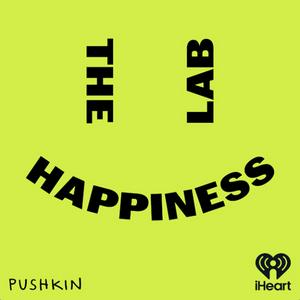
The Happiness Lab with Dr. Laurie Santos
Pushkin Industries
Latest episode
284 episodes
Why Happiness Experts Still Struggle to Be Happy with Dr. Ethan Kross
2026-10-19 | 52 mins.You might assume that people who study happiness for a living have it all figured out. But even happiness experts struggle to follow their own advice. They know the science behind feeling happier, managing difficult emotions, and building healthier habits — but putting that knowledge into practice is another story. Why is it so hard to do the things we know are good for us?
In a live conversation recorded at SXSW, Dr. Laurie gets personal with her good friend, psychologist Ethan Kross, about the times they've struggled to practice what they preach. Together, they explore the psychological biases that can get in our way and share science-backed strategies for managing difficult emotions, building better habits, and turning that knowledge into action.
Experts Mentioned:
Ethan Kross, Professor of Psychology at the University of Michigan
Tamar Gendler, Professor of Philosophy and Dean of the Faculty of Arts and Sciences at Yale University
Gabriele Oettingen, Professor of Psychology at New York University and the University of Hamburg
Carey Morewedge, Professor of Marketing at Boston University
Christina Maslach, Professor Emerita of Psychology at the University of California, Berkeley
Kristin Neff, Associate Professor of Educational Psychology at the University of Texas at Austin
Resources Mentioned:
Shift: Managing Your Emotions — So They Don't Manage You, by Ethan Kross (2025)
Chatter: The Voice in Our Head, Why It Matters, and How to Harness It, by Ethan Kross (2021)
“Knowing is Half the Battle,” by Laurie Santos and Tamar Gendler (Edge, 2014)
Müller-Lyer Illusion
“Exploring Solomon’s Paradox: Self-Distancing Eliminates the Self-Other Asymmetry in Wise Reasoning About Close Relationships in Younger and Older Adults,” by Igor Grossmann and Ethan Kross (Psychological Science, 2014)
WOOP: Wish, Outcome, Obstacle, Plan
Rethinking Positive Thinking: Inside the New Science of Motivation, by Gabriele Oettingen (2014)
“Thought for Food: Imagined Consumption Reduces Actual Consumption,” by Carey Morewedge, Young Eun Huh, and Joachim Vosgerau (Science, 2010)
“Forming a flossing habit: an exploratory study of the psychological determinants of habit formation,” by Gaby Judah, Benjamin Gardner, and Robert Aunger (British Journal of Health Psychology, 2013)
How to Change: The Science of Getting from Where You Are to Where You Want to Be, by Katy Milkman (2021)
Burnout: The Cost of Caring, by Christina Maslach (1982)
Self-Compassion: The Proven Power of Being Kind to Yourself, by Kristin Neff (2011)
“Self-Perception Theory,” by Daryl J. Bem (Advances in Experimental Social Psychology, 1972)
“Emotion Controllability Beliefs and Young People's Anxiety and Depression Symptoms: A Systematic Review,” by Matthew Somerville, Helen MacIntyre, Amy Harrison, and Iris Mauss (Adolescent Research Review, 2024)
“Implicit theories of emotion: Affective and social outcomes across a major life transition,” by Maya Tamir, Oliver John, Sanjay Srivastava, and James Gross (Journal of Personality and Social Psychology, 2007)
Related Episodes:
“For Whom the Alarm Clock Tolls”
“Harnessing People Around us to Feel Happier (Live with Ethan Kross)”
“Coach Yourself Through a Crisis”
“Don’t Accentuate the Positive”
See omnystudio.com/listener for privacy information.What Gets Lost When We Text Instead of Talk with Dr. Nick Epley
2026-10-12 | 44 mins.For most of human history, we only had one way to talk to one another: our voices. Today, we have more ways to communicate than ever before. We can text, call, send a video message, reach out over social media, et cetera. And we often choose whichever option seems easiest or least awkward. But research suggests that how we choose to communicate matters much more than we realize and can have a surprising impact on how well we understand one another and how connected we feel.
In a live conversation recorded at the World Happiness Summit at SXSW, Dr. Laurie speaks with psychologist Nick Epley about the common mistakes we make when communicating in the modern world — and the small changes that could help us connect more meaningfully with the people around us. His new book, A Little More Social, is available now.
Experts Mentioned:
Nicholas Epley, Professor of Behavioral Science at the University of Chicago Booth School of Business
Bronisław Malinowski, Polish anthropologist and ethnologist
Resources Mentioned:
A Little More Social: How Small Choices Create Unexpected Happiness, Health, and Connection, by Nick Epley (2026)
“Hello, stranger? Pleasant conversations are preceded by concerns about starting one,” by Juliana Schroeder, Donald Lyons, and Nicholas Epley (Journal of Experimental Psychology: General, 2022)
"The Problem of Meaning in Primitive Languages," by Bronisław Malinowski (1923)
“Is Conversation Magical?,” by Nicholas Epley (Chicago Booth Review, 2026)
“The Humanizing Voice: Speech Reveals, and Text Conceals, a More Thoughtful Mind in the Midst of Disagreement,” by Juliana Schroeder, Michael Kardas, and Nicholas Epley (Psychological Science, 2017)
"Egocentrism over e-mail: can we communicate as well as we think?," by Justin Kruger, Nicholas Epley, Jason Parker, and Zhi-Wen Ng (Journal of Personality and Social Psychology, 2005)
“The Sound of Intellect: Speech Reveals a Thoughtful Mind, Increasing a Job Candidate's Appeal,” by Juliana Schroeder and Nicholas Epley (Psychological Science, 2015)
“It's surprisingly nice to hear you: Misunderstanding the impact of communication media can lead to suboptimal choices of how to connect with others,” by Amit Kumar and Nicholas Epley Journal of Experimental Psychology: General, 2021)
Related Episodes:
Forget Small Talk: Go Deep Instead
You’re Actually Not Bothering People Enough
Why Giving is a Great Daily Habit
The Surprising Case for Oversharing
See omnystudio.com/listener for privacy information.Finding the Magic in Everyday Life with Thoreau and Eric Weiner
2026-10-05 | 33 mins.As we move through our busy lives, it’s easy to stop noticing the tiny, beautiful things all around us. But rediscovering the sense of wonder we had as children might not only bring us more joy — it could also help us better navigate life’s hardest moments.
Dr. Laurie explores that idea with traveling philosopher and former NPR correspondent Eric Weiner, author of The Socrates Express: In Search of Life Lessons from Dead Philosophers. Eric shares what he’s learned from walking in the footsteps of Henry David Thoreau, including how the 19th-century philosopher can help us live better in the modern day and see beauty in the things we usually overlook.
Experts Mentioned:
Eric Weiner, journalist, author, and philosophical traveler
Henry David Thoreau, 19th-century American philosopher, poet, environmental scientist, and political activist
Socrates, ancient Greek philosopher
Epicurus, ancient Greek philosopher
Arthur Schopenhauer, 19th-century German philosopher
Ralph Waldo Emerson, 19th-century essayist, poet, and philosopher
Confucius, ancient Chinese philosopher
Nathaniel Hawthorne, 19th-century American novelist and short-story writer
Leslie Perrin Wilson, author and former curator of the Special Collections at the Concord Free Public Library
Henry Miller, American novelist, short-story writer, and essayist
Resources Mentioned:
The Socrates Express: In Search of Life Lessons from Dead Philosophers, by Eric Weiner (2020)
Walden, by Henry David Thoreau (1854)
“Walking,” by Henry David Thoreau (1862)
Bhagavad Gita (second or first century BCE)
The Journal of Henry David Thoreau
“The playful mediator, moderator, or outcome? An integrative review of the roles of play and playfulness in adult-centered psychological interventions for mental health,” by Xiangyou Shen and Leland Masek (The Journal of Positive Psychology, 2024)
Related Episodes:
“Happiness Lessons of The Ancients: Confucius”
“The Science of Attention and Distraction”
“The Power of Awe… and Where to Find it”
“Sight and Sound: How to Joyfully Awaken Your Senses”
See omnystudio.com/listener for privacy information.Want More Joy? Try Taking Yourself Less Seriously with Comedian Chris Duffy
2026-09-28 | 45 mins.When we’re exhausted, overworked, or just going through a difficult time, our instinct is often to put our heads down and simply focus on getting through it. But those serious moments may actually be when we benefit from a little silliness and absurdity the most.
Laurie explores the science of humor with comedian Chris Duffy, host of How to Be a Better Human and author of the new book Humor Me: How Laughing More Can Make You Present, Creative, Connected, and Happy. Chris shares what he’s learned about how to find humor in almost any situation — and how embracing the funny can improve our wellbeing in surprising ways.
Experts Mentioned:
Chris Duffy, comedian, author, and host of How to Be a Better Human
E. B. White, writer and essayist
Mimi M.Y. Tse, Assistant Professor at The Hong Kong Polytechnic University
Ross Gay, poet, essayist, and Professor of English at Indiana University
Annie Rauwerda, creator of “Depths of Wikipedia”
Aparna Nancherla, comedian and author
Greg Bryant, Professor of Communication at UCLA
Adam Mastroianni, experimental psychologist and author
Resources Mentioned:
Humor Me: How Laughing More Can Make You Present, Creative, Connected, and Happy, by Chris Duffy (2026)
How to Be a Better Human, TED podcast hosted by Chris Duffy
“The impression management benefits of humorous self-disclosures: How humor influences perceptions of veracity,” by T. Bradford Bitterly and Maurice Schweitzer (Organizational Behavior and Human Decision Processes, 2019)
“The effect of a pratfall on increasing interpersonal attractiveness,” by Elliot Aronson, Ben Willerman, and Joanne Floyd (Human Learning and Thinking, 1966)
“Humor Therapy: Relieving Chronic Pain and Enhancing Happiness for Older Adults,” Mimi Tse, Anna Lo, Tracy Cheng, Eva Chan, Annie Chan, and Helena Chung (Journal of Aging Research, 2010)
The Book of Delights: Essays, by Ross Gay (2019)
Listers: A Glimpse Into Extreme Birdwatching, directed by Owen Reiser (2025)
“Depths of Wikipedia”
“Hello, stranger? Pleasant conversations are preceded by concerns about starting one,” by Juliana Schroeder, Donald Lyons, and Nicholas Epley (Journal of Experimental Psychology: General, 2022)
“The Perception of Spontaneous and Volitional Laughter Across 21 Societies,” by Greg Bryant et al. (Psychological Science, 2018)
“Neural substrates of spontaneous musical performance: an FMRI study of jazz improvisation,” by Charles Limb and Allen Braun (PLoS One, 2008)
“Good conversations have lots of doorknobs,” by Adam Mastroianni (Experimental History, 2022)
Related Episodes:
“Laurie Gets a Fun-tervention (Part One)”
“The Surprising Case for Oversharing”
“How To Embrace Imperfection”
See omnystudio.com/listener for privacy information.Small Steps to Happiness: The Science of Mindful Living with Laurie Santos | From The One You Feed
2026-09-25 | 1h 6 mins.Today we're sharing author Eric Zimmer’s interview with Dr. Laurie on The One You Feed podcast.
In this episode, Dr. Laurie Santos discusses the importance of taking small steps to happiness and the science of mindful living. She reminds us that happiness is not a destination, but a practice. By understanding the science behind well-being and implementing small, consistent changes, we can learn how to apply these insights to our own lives to find greater joy and fulfillment.
Key Takeaways:
Embrace the power of small, consistent actions in shaping our happiness
Understand how our environment and social connections influence our behavior
Learn the common misconceptions about what truly makes us happy
Discover strategies for overcoming loneliness and building meaningful connections
If you like what you hear, find The One You Feed wherever you get podcasts.
See omnystudio.com/listener for privacy information.
More Health & Wellness podcasts






Trending Health & Wellness podcasts





About The Happiness Lab with Dr. Laurie Santos
The Happiness Lab is serving up scientifically-backed takes this summer that are so hot, even your SPF 50 won’t protect you.
With the help of behavioral scientists, historians, and cultural critics, Yale psychologist Dr. Laurie Santos challenges some of our biggest assumptions about what it takes to live a good life. Dr. Laurie explores topics like why we should forget about TMI and lean into oversharing, how dumping small talk makes for better conversations, why the kids these days are actually doing just fine, and how men can establish strong bromances. Each episode unpacks a bold, counterintuitive claim — using research, data, and expert insight to question the conventional wisdom around happiness and wellbeing.
Podcast websiteListen to The Happiness Lab with Dr. Laurie Santos, White Coat, Black Art and many other podcasts from around the world with the radio.net app
Get the free radio.net app
- Stations and podcasts to bookmark
- Stream via Wi-Fi or Bluetooth
- Supports Carplay & Android Auto
- Many other app features
Get the free radio.net app
- Stations and podcasts to bookmark
- Stream via Wi-Fi or Bluetooth
- Supports Carplay & Android Auto
- Many other app features

The Happiness Lab with Dr. Laurie Santos
Scan code,
download the app,
start listening.
download the app,
start listening.
The Happiness Lab with Dr. Laurie Santos: Podcasts in Family

 Canada - english