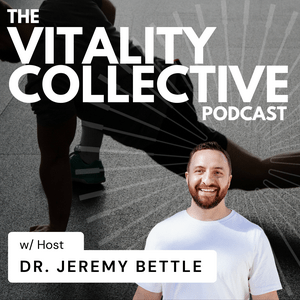
PodcastsHealth & WellnessThe Vitality Collective Podcast w/Dr. Jeremy Bettle

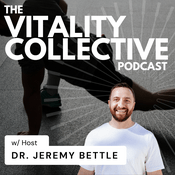
The Vitality Collective Podcast w/Dr. Jeremy Bettle

Dr. Jeremy Bettle
The Vitality Collective Podcast w/Dr. Jeremy Bettle
Latest episode

64 episodes

  • The Vitality Collective Podcast w/Dr. Jeremy Bettle

    EP 63: GLP-1 Drugs and Muscle Loss with Dr. Stuart Phillips

    2026-03-11 | 1h 21 mins.
    Episode Summary
    GLP-1 medications like semaglutide are everywhere, from your doctor's office to the Super Bowl, and the conversation has moved well beyond clinical use. In this episode, Dr. Jeremy Bettle sits down with Dr. Stuart Phillips, one of the world's leading researchers in muscle metabolism and aging, to cut through the noise on weight loss drugs. They cover what these medications actually do in the body, why losing weight without resistance training and proper nutrition is a serious long-term risk, and how to protect your muscle mass, bone density, and metabolic health if you are going to use them. This is not a conversation about whether GLP-1s are good or bad. It is a conversation about using them responsibly, with the full picture.
     
    Guest Bio
    Dr. Stuart Phillips is a Distinguished Professor of Kinesiology at McMaster University and director of the Physical Activity Centre of Excellence (PACE). His groundbreaking research explores muscle metabolism, protein needs, and aging, revealing the transformative power of strength training and nutrition. With 28 years of pioneering work in the field, Dr. Phillips is an evidence-based advocate for accessible, impactful interventions to improve healthspan and mobility.
     
    Links
    Instagram: @mackinprof

    X: @mackinprof

    LinkedIn: search Stuart Phillips

     
    Three Actionable Takeaways
    Be honest with yourself about why you want to take these drugs, and if it is aesthetic, commit to learning how to lift weights. Simply taking the drug without building the habits around strength training is ultimately not going to be helpful. Resistance exercise is the foundational piece that protects your muscle and bone while on a low-calorie budget, and starting that practice now is an investment that pays you back for decades.

    Pair any weight loss effort with nutrient-dense protein and consider working with a dietitian. When your appetite is suppressed, every bite counts more. Prioritizing protein-rich, micronutrient-dense foods over energy-dense, nutrient-poor choices is how you lose fat rather than muscle. Dietetic support is not a luxury here, it is one of the most practical things you can do to protect your long-term health.

    Treat this as a teachable moment, not a finish line. Whether you are taking GLP-1s for aesthetic reasons or genuine clinical need, the goal is to use the reduced food noise as a reset. Build the habits now, including the exercise, the nutrition, the hydration, and the monitoring, so that if and when you come off the drug, your body is stronger than when you started.

     
    Key Insights
    GLP-1 is a naturally occurring hormone. Semaglutide mimics it, suppressing appetite centrally and slowing gastric emptying. Receptors for GLP-1 are found throughout the body including the brain, gut, heart, and vasculature, which is why the drug has wide-ranging effects beyond just appetite reduction.

    Up to 40% of the weight lost on GLP-1 trials is lean mass, not fat. Roughly half of that lean mass loss is muscle. In practical terms, some trial data suggests a year on these drugs can produce muscle loss equivalent to approximately a decade of normal aging.

    When you stop the drug and regain weight, you gain fat, not muscle. Weight regain after stopping GLP-1s is almost entirely body fat, which means you can end up in a worse metabolic position than when you started if you haven't built a protective base of muscle.

    Micronutrient deficiencies are a real and underappreciated risk. Cutting food intake dramatically means calcium, vitamin D, iron, vitamin B12, and magnesium can all drop to concerning levels. A food-first approach to nutrient density is preferable to relying on supplements alone.

    Bone density goes in the wrong direction without the right interventions. One drug-company-run trial looking at bone density showed it declined, not improved. Resistance exercise, calcium, vitamin D, and adequate protein are the three nutrients and the stimulus that bone requires.

    Dehydration is a common and overlooked side effect. These drugs suppress the desire to drink as well as eat. Monitoring hydration is important, particularly for those experiencing elevated resting heart rate while on the medication.

    Real-world discontinuation rates are high. One study of 700,000 people found that 50% of users were off the drugs within a year, primarily due to cost and side effects. Trial data does not reflect what actually happens in the general population.

    For resistance training, the rep range matters less than the intensity. Anywhere from 3 to 25 repetitions can build muscle and bone effectively, provided the final reps are genuinely hard, approximately 1 to 2 reps shy of failure. Consistency over time matters more than any specific protocol.

    Protein targets should be roughly double the standard RDA. The RDA of 0.8g per kg of body weight is too low for most adults, and especially for those in a caloric deficit. Dr. Phillips points to approximately 1.6g per kg (0.7g per pound) as a more appropriate target, combined with resistance exercise.

    The case for GLP-1s is strongest where the clinical need is clearest. For people with a BMI over 30 and additional metabolic risk factors, the benefits, including reductions in major cardiovascular events, are substantial and well supported. The risk-benefit picture looks very different for someone who simply wants to lose 10 to 15 pounds.
  • The Vitality Collective Podcast w/Dr. Jeremy Bettle

    EP 62: Focus, Attention and Brain Health: The Science of Cognitive Performance

    2026-03-04 | 1h 24 mins.
    Episode Summary
    In this episode, Jeremy sits down with Noah Rolland, CEO of NeuroTrainer and Smileyscope, to dig into the science of focus, attention, and long-term cognitive performance. They cover how the brain actually trains itself, why task-switching is harder than most people think, and what separates elite cognitive performers from everyone else. From neuroplasticity and VR-based brain training to the role of meditation, sleep, and cardiovascular fitness, this conversation makes a clear case that cognitive performance is trainable and that most of us are working against ourselves without realizing it. If you want to sharpen your focus and protect your brain for the long haul, this one is worth your full attention.
    Guest Bio
    Noah Rolland is a technology CEO and human performance advocate focused on advancing brain health, cognitive performance, and lifelong vitality. He serves as CEO of NeuroTrainer, a neuroscience-based VR platform designed to strengthen focus, decision-making, and mental resilience in athletes, military professionals, and high performers, and as CEO of Smileyscope, the first FDA-cleared virtual reality analgesic transforming how patients experience medical procedures. Through both companies, he leads the development of immersive technologies grounded in neuroscience and clinical science to reduce pain, improve performance, and protect long-term brain function. He is also the host of the FocusMatters podcast, where he speaks with experts across medicine, sport, defense, and human optimization about preserving cognitive capacity, enhancing attention, and building durable mental performance across the lifespan. A lifelong student of strength training, recovery, and disciplined living, he integrates science with daily practice in pursuit of sustained health, resilience, and peak performance at every age.
    Links
    NeuroTrainer: neurotrainer.com

    Contact Noah directly: [email protected]

    FocusMatters Podcast: search "FocusMatters" wherever you listen to podcasts
    YouTube
    Apple
    Spotify

    Waking Up (meditation app by Sam Harris): wakingup.com

    Three Actionable Takeaways
    Build your cardiovascular fitness as the foundation for focus. Noah's first move for anyone looking to improve cognitive performance is consistent aerobic exercise. The research is clear: cardiovascular fitness has a direct impact on how well your brain functions and how reliably you can access focus on demand. You don't need a complex program, you just need to move consistently.


    Prioritize sleep quality and protect your sleep routine with consistency. The information on sleep hygiene is widely available, but consistency is the lever most people overlook. Protect your pre-sleep routine the same way you protect your training schedule, because without it, nothing else you do for focus will land the way it should.


    Develop a dedicated focus practice that is separate from your work. Whether it's meditation, Tai Chi, kettlebell swings with full presence, or a tool like NeuroTrainer, you need a practice for training attention that is disconnected from your job or your goals. When your focus practice has no stakes, you can learn what focus actually feels like and build from there. That awareness is what gives you the ability to catch yourself when you drift.


    Key Insights
    Brain training and brain games are not the same thing. Games like Lumosity create the feeling of productivity but rely on rote repetition. Genuine brain training leverages neuroplasticity through sustained challenge, complex decision-making, and full cognitive engagement over time.


    VR is uniquely suited for cognitive training because it captures complete attention and creates controlled, scalable stress on the brain. The immersive environment allows trainers to manipulate cognitive load in ways flat screens or traditional methods cannot replicate.


    Cognitive priming can shorten the ramp-up time to peak focus. By triggering norepinephrine, acetylcholine, and dopamine in sequence, a focused pre-session activity can prime the brain for deep work before the real task begins. This "focus cocktail" is something NeuroTrainer deliberately produces in as little as five minutes.


    NeuroTrainer does not make you a better athlete directly. It increases your potential to access physical skills. If your gap is decision speed, reading the field, or mental resilience under pressure, training the brain closes that gap. If you cannot swing a bat, no cognitive tool will fix that.


    What separates elite performers from sub-elite performers is often cognitive, not physical. Jeremy's PhD research in reactive agility found that elite movers read and react to stimuli as fast in unpredictable conditions as in planned ones. Sub-elite athletes were often physically superior but cognitively slower, and that gap cost them.


    Task switching costs you more time than you think. After a true distraction, it takes the average person approximately 20 minutes to return to a focused state. Multitasking is largely a myth, and the more tasks you switch between, the more overall performance degrades unless you have specifically trained for it.


    We are always training our attention, intentionally or not. Smartphone use, social media scrolling, and constant context-switching are training the brain to expect fragmented input and short reward loops. That conditioning works against sustained focus whether you recognize it as training or not.


    Meditation is a trainable skill, not a personality trait. The most common reason people quit is they feel like they are bad at it. But noticing distraction and returning to the present moment is the practice, not a failure. That return is exactly the rep that builds attentional control over time.


    If sitting still is not accessible, a moving contemplative practice works just as well. Tai Chi, walking meditation, and similar practices train the same core skill: bringing your attention to what is happening right now. For people with ADHD or high arousal needs, these formats are a practical on-ramp to a focus practice.


    Self-judgment and comparison culture actively undermine cognitive performance. Noah's closing message was direct: wherever you are right now is where you are, and that is the only honest starting point. Journaling, gratitude, and practicing grace for yourself are not soft skills. They are structural supports for the kind of sustained effort that long-term performance requires.

  • The Vitality Collective Podcast w/Dr. Jeremy Bettle

    EP 61: High-Performance Recovery with Dr. Robin Thorpe: Match Recovery to the Response You Want

    2026-02-25 | 1h 10 mins.
    Episode Summary
    Recovery is one of the most misunderstood concepts in both elite sport and everyday high performance. In this episode, Jeremy sits down with Dr. Robin Thorpe, former Head of Recovery and Regeneration at Manchester United, to cut through the noise around wearables, HRV, cold water immersion, and recovery stacking. They break down what recovery actually means from a physiological standpoint, how to identify which systems are under stress, whether that is muscular, cognitive, or central nervous system, and how context should drive every intervention decision. Whether you are a professional athlete, a C-suite executive, or simply someone trying to perform at your best, this conversation gives you a more honest and practical lens for thinking about recovery.
    Guest Bio
    Dr. Robin Thorpe spent a decade as Head of Recovery and Regeneration at Manchester United Football Club, working across six managerial regimes and contributing to 10 national and international titles. He completed an applied PhD with Liverpool John Moores University focused on tracking and managing recovery, with multiple peer-reviewed publications to his name. Dr. Thorpe holds positions as Visiting Research Fellow at Liverpool John Moores University and Adjunct Professor at Arizona State University. His career spans elite football, track and field (including Olympic Gold Medalists and World Record Holders in the lead-up to Tokyo 2020), and the Mexican national team at the 2018 FIFA World Cup. He has consulted across the EPL, NBA, MLB, MLS, and PGA Tour, served as Director of Performance at Red Bull in Los Angeles, and continues to work with professional sports teams and organisations across the US and Europe.
    Links
    Linkedin: Robin Thorpe, PhD
    Instagram: @dr.robinthorpe
    Three Actionable Takeaways
    Start with context before choosing any recovery intervention. Know whether your goal is to recover as quickly as possible or to maximise adaptation and fitness gains, because that single question should determine every decision you make about recovery tools and timing.
    Track the right systems, not just the overall load. Recovery is not one thing. Try to identify which system is most under stress, whether that is cognitive and psychological, muscular and structural, or central nervous system, and then monitor and respond to that system specifically rather than applying a blanket approach.
    Sequence your recovery modalities rather than stacking them. Applying multiple interventions at once does not compound the benefit and may actually reduce the effect of each. Match the right modality to the right system at the right time, and build from your fundamentals of sleep, nutrition, cognitive rest, and load periodisation before adding anything more complex.
    Key Insights
    HRV is a useful but widely misunderstood metric. Variability between heartbeats indicates parasympathetic or sympathetic dominance, but the number is highly individual, context-dependent, and far more complex than the green or red readouts on consumer wearables suggest.
    Recovery can be understood as a temporary reduction in function following physical or psychological stress, before a return to baseline or a higher adapted state. The goal of recovery interventions is to accelerate that return, or in some contexts, to amplify the adaptation itself.
    The four key systems to consider when assessing recovery are: psychological and cognitive, muscular structural, metabolic, and central nervous system. Each has a different timeline and responds to different interventions.
    Cold water immersion is a context-specific tool, not a universal recovery solution. It is well-suited to reducing the secondary damage phase following high eccentric load, but it can blunt adaptation during pre-season or hypertrophy-focused phases, and it reduces amino acid incorporation into muscle tissue.
    External load data alone is not enough to make sound recovery decisions. Two athletes performing the same training volume can have very different physiological responses depending on psychological, social, and contextual factors happening at the same time.
    The concept of allostasis is important for understanding recovery. Both physical and psychological stressors disrupt the body's equilibrium, and recovery interventions need to account for the full load an individual is carrying, not just what happened in the training session.
    For cognitively and psychologically loaded performers such as executives or leaders, parasympathetic reactivation techniques like mindfulness, breathing work, or structured relaxation of 15 to 45 minutes have shown acute positive effects and are worth weaving into the daily schedule.
    The field of recovery science has not advanced as dramatically in the last 15 years as the consumer wearable market suggests. Many metrics and modalities being marketed to general populations have outpaced the actual evidence for their practical impact.
    Periodising nutrition in line with recovery goals is an underutilised strategy. Anti-inflammatory foods, nitrates for circulation, and protein timing relative to cold water immersion are all areas where nutrition and recovery science intersect in meaningful ways.
    Robin predicts that post-training intervention sessions will become as standard as pre-training activation work. In some contexts this will focus on recovery, while in others it will be designed as an adaptation enhancement session using tools like heat exposure to amplify training signals.
  • The Vitality Collective Podcast w/Dr. Jeremy Bettle

    EP 60: Low Back Pain, Sciatica, and Building a Resilient Spine

    2026-02-18 | 1h 30 mins.
    Description
    Low back pain and sciatica are some of the most common injuries in both athletes and everyday high performers. Yet most back pain is misunderstood, over-medicalized, and managed with fear.
    In Episode 60 of The Vitality Collective Podcast with Dr. Jeremy Bettle, Dr. Jeremy sits down with Dr. Brian Wolfe to break down what is actually happening when your back "goes out."
    They discuss:
    • What disc injuries are and how they really behave
    • Why MRI findings often do not match your symptoms
    • The difference between muscular soreness and nerve pain
    • How fear of movement turns acute back pain into chronic pain
    • Why sitting and poor load management drive flare-ups
    • When rest, injections, or surgery may have a role
    • How progressive strength training builds a resilient spine
    Back pain is complex. But it is also trainable.
    If you have ever been told you "have a bad back," this conversation will challenge that narrative and give you a smarter path forward.
    Listen now to learn how to reduce low back pain, manage sciatica, and build long-term spine resilience.
    Guest Bio
    Dr. Brian Wolfe, DPT, is a co-founder and owner of Evolution Physical Therapy and a recognized leader in sports medicine, focusing on injury prevention, rehabilitation, and performance enhancement. He holds a Doctorate in Physical Therapy from Ithaca College and is a board-certified Orthopedic Clinical Specialist. With a robust background in professional sports, Dr. Wolfe served as a physical therapist for the Premier Lacrosse League from 2019 to 2021 and currently works with New York City Football Club. Overseeing Evolution Physical Therapy's East Coast operations, he leads a distinguished practice with locations in Greenwich, Darien, Stamford, Norwalk, CT, and Farmingdale, Long Island. An engaging speaker, Dr. Wolfe shares his deep expertise in pain management, mobility, and wellness, empowering audiences to pursue lifelong health and vitality.
    Links
    Evolution Physical Therapy: evolutionphysicaltherapy.com

    Physio Growth (mentorship): physio-growth.com

    Brian on Instagram: @BTWolf02

    Evolution PT on Instagram: @evolutionPTfit (main), @evolutionPTfit_CT

    Brian Wolfe, PT, DPT, OCS on LinkedIn

    Three Actionable Takeaways
    Build a simple, condensed yoga or mobility routine into your day. You don't need a full 60-minute class. Focus on warrior poses, triangle poses, cobras, prayer stretches, and basic vinyasa flows to move your spine through multiple planes of motion. Even five minutes of this can make a meaningful difference in how your back feels.

    Work with a qualified practitioner in physical medicine who can guide your movement. Whether that is a physical therapist, a chiropractor, or a strength coach, having someone who understands your mechanics and can program specifically for you is one of the best investments you can make in your spinal health.

    When you have a back pain episode, choose motion over rest. Your spine responds better to movement than it does to lying still, medication, or jumping straight to surgery. Build a plan that includes what you do daily for prevention, what you do when a flare-up hits, and who you see when you need professional help.

    Key Insights
    The spine is a complex, multi-joint structure that moves in three planes (flexion/extension, rotation, side bending) across cervical, thoracic, lumbar, and sacral regions, making it far harder to assess than a single joint like the shoulder.

    Discs are highly innervated structures, and discogenic problems can manifest as back pain, hamstring soreness, calf tightness, hip flexor issues, or shooting pain down the leg, all from the same underlying cause.

    MRI findings often do not correlate with pain levels. Many people have disc bulges with no symptoms, and others have severe pain with clean imaging, so imaging alone should not dictate treatment.

    The legs are the true shock absorbers of the body, not the discs. As we lose muscle strength, our joints absorb more force, which increases injury risk.

    Sitting is one of the highest-risk activities for the spine because of the sustained compressive load it places on the discs. Prolonged sitting followed by heavy loading is a recipe for injury.

    The pain cycle works like a stereo dial. After an injury, the nervous system can stay turned up to a seven or eight, meaning you feel pain faster, more intensely, and for longer than you should. Breaking that cycle requires intentional movement, not avoidance.

    Unilateral symptoms (one-sided soreness in the back, hamstring, or glute) are often a warning sign of a discogenic issue, while symmetrical post-exercise soreness is typically muscular.

    Rehab should follow a clear continuum: address pain first, then fix the underlying problem, then build injury prevention through strength, and finally progress to performance training.

    The gap between physical therapy and performance training is where many people get reinjured. Communication between practitioners (physicians, PTs, trainers) is essential and often lacking.

    A subsequent back injury should be treated as a new injury, not a re-injury. Framing it as new helps psychologically break the chronic pain cycle and reinforces that the original tissue has healed.
  • The Vitality Collective Podcast w/Dr. Jeremy Bettle

    EP 59: Strength Training for Longevity | The Truth About Lifting Heavy with Mike Boyle

    2026-02-11 | 1h 9 mins.
    Episode Summary
    Legendary strength coach Mike Boyle joins the show to discuss practical strength training for longevity and why the conversation around lifting heavy has gotten out of hand. We cover the recent controversy sparked by Mike's social media post about one-rep maxes, why the 5-10 rep range is the sweet spot for most people, and how researchers and influencers are creating confusion by promoting messages without context on how to get there safely. Mike shares his philosophy on safe and smart training, the importance of cardiovascular intervals, and why showing up consistently matters more than any specific program. If you're navigating conflicting advice about how heavy you should lift or how hard you should train, this conversation cuts through the noise.
     
    Guest Bio
    Mike Boyle is co-founder and current partner in Mike Boyle Strength and Conditioning and co-founder of Certified Functional Strength Coach. He is an international presenter and educator, and formerly served as strength and conditioning coach for the Boston Red Sox, Boston Bruins, Boston University, and US Women's National Ice Hockey team. Mike is the author of Designing Strength Training Programs and Facilities, New Functional Training for Sports, and Advances in Functional Training. He is known for his no-nonsense approach to training and his commitment to safe, effective programming for athletes and adults of all ages.
     
    Links
    strengthcoach.com (online forum, $14.95/month)

    Books available on Amazon:
    Designing Strength Training Programs and Facilities,

    New Functional Training for Sports,

    Advances in Functional Training


    Instagram: @mbsc_online
     
    Three Actionable Takeaways
    Show up. Commit to two total body workouts a week, every week, and don't miss. Consistency over time is the single most powerful variable in your training, and there is no program that compensates for not showing up.


    Once you're consistent, work toward three days a week. Most people train twice a week, and simply adding one more session creates a meaningful difference in strength, muscle mass, and bone density over the long term.


    Add at least one cardiovascular session per week where you rev the engine. Using a non-weight-bearing option like an assault bike, push into short aggressive intervals that get you out of breath and elevate your heart rate, building toward this after an appropriate acclimation period.


    Key Takeaways
    Researchers and health influencers saying "lift heavy" are delivering an important message, but without context on how to get there safely, it creates confusion and emboldens approaches that are not appropriate for most people.


    The 5-10 rep range sits at roughly 77-87% of a one-rep max, and Mike considers this the safe and effective zone for adult populations. Going above 90% tilts the risk-to-reward ratio in the wrong direction for most people.


    One-rep max testing is not where the adaptation happens. The study Mike reviewed used lat pull-downs and leg extensions to claim 1RM testing in older adults was safe, then conclusions were extended to squats and deadlifts. That is not what the research said.


    Single-leg training and bilateral training produce comparable lower body strength outcomes. Attributing results to a specific exercise rather than the underlying adaptation is a common error when interpreting research.


    Studies on strength training are often measuring the test, not the result. Lower body strength measured by squats and lower body strength measured by a trap bar deadlift are the same quality, just different tools.


    Professional athletes who have trained for decades commonly develop joint issues over time. Outliers who feel fine are not representative of the normal population, and program design must account for the accumulated orthopedic cost of training.


    For older adults, not declining is progressing. Maintaining fitness levels into your 60s and 70s puts you ahead of the vast majority of the population, even if you are no longer improving.


    The first 15 minutes of a workout, including foam rolling, tissue prep, and mobility work, is the most important part of the session and the part most people skip entirely.


    The formula of 220 minus age for maximum heart rate is not accurate for fit older individuals. Mike, at 66, routinely reaches heart rates in the 160s and has hit 184.


    Only about 5% of the population exercises properly. The opportunity to help people is enormous, and the arguments happening online about rep ranges and methods are happening within a tiny fraction of the people who actually need to hear any of it.

More Health & Wellness podcasts

About The Vitality Collective Podcast w/Dr. Jeremy Bettle

Welcome to The Vitality Collective Podcast—your guide to living a life of strength, resilience, longevity, and vibrant health. Hosted by Dr. Jeremy Bettle, PhD—an internationally recognized expert in Human Performance with over 20 years of experience working with elite athletes and high performers—this podcast brings world-class expertise straight to you. Join us as we dive deep into vitality, uncovering groundbreaking insights from leading experts in longevity, performance, nutrition, sleep, brain health, emotional well-being, and proactive medicine. Through engaging conversations and actionable insights, we'll empower you to unlock your potential, push past your limits, and make every day better! Whether you're looking to prevent illness, enhance performance, or simply feel your best, The Vitality Collective Podcast w/Dr. Jeremy Bettle is here to inspire, educate, and motivate you to thrive. Thank you for listening. https://www.vitality-collective.com IG: https://www.instagram.com/vitalitycollectivemontecito LI: https://www.linkedin.com/in/vitalitycollective
Podcast website

Listen to The Vitality Collective Podcast w/Dr. Jeremy Bettle, 10% Happier with Dan Harris and many other podcasts from around the world with the radio.net app

Get the free radio.net app

  • Stations and podcasts to bookmark
  • Stream via Wi-Fi or Bluetooth
  • Supports Carplay & Android Auto
  • Many other app features

The Vitality Collective Podcast w/Dr. Jeremy Bettle: Podcasts in Family

Social
v8.7.2 | © 2007-2026 radio.de GmbH
Generated: 3/13/2026 - 5:42:48 PM